
Sound Stories 17th–19th June 2026
News
May 09, 2026
Northumbria University, in collaboration with the Galpin Society and the UKRI Global Music Technologies research group, will host the Sound Stories Conference on 17–19 June 2026 in Newcastle Upon Tyne, England.
The conference aims to examine potential gaps in organology and to highlight forgotten or emerging analytical approaches. Its goal is to bring together diverse voices, studies, and musical traditions.
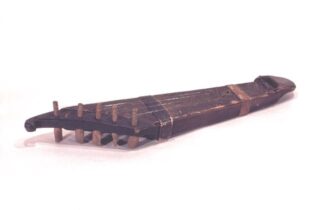
A five-string kantele from Heinävesi from the early 1800’s. The National Museum of Finland, KF2016, Ethnographic Collections.
Arja Kastinen will participate in the conference with the presentation: Carved Kanteles as Embodied Aesthetics of Runosong Culture: Reconsidering Instrument Design Through Cultural Function.
The presentation discusses the essence and structural features of the Finnish–Karelian carved kantele as part of the sonic ideals and musical meanings of runosong culture.
The development of the instrument’s regional specificities is therefore examined within the broader evolution of the musical culture and the aesthetics it required.

A 12-string kantele made by Hilppa Vornanen from Korpiselkä. The National Museum of Finland, Ethnographic Collections, KF1178. Photo: Arja Kastinen.
The historical performance practices and the old plucking technique, together with the mythical beliefs associated with the ancient carved kantele, link many of the instrument’s Finnish–Karelian structural features to the region’s runosong culture.
From a musician’s perspective, the emergence of these regional characteristics appears as an enabler of particular aesthetics and culturally embedded musical requirements. From this viewpoint, the Finnish–Karelian carved kantele—although belonging to the family of Baltic psalteries—is not merely a locally inflected branch of that instrument group, but rather its own offshoot, whose structure was shaped to suit the musician’s playing technique.
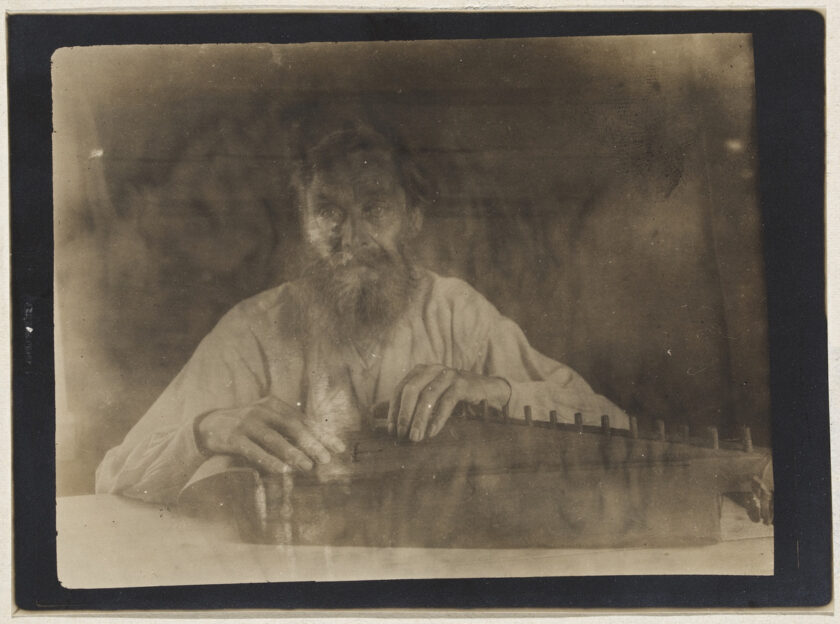
Hilppa Vornanen, Korpiselkä, Ristisalmi. Photo: A. O. Väisänen, 1910’s. The Finnish Heritage Agency, Etnographic Picture Collections, finna.fi.
The development and use of the instrument appear as a chain of meanings in which the playing technique was closely linked to the musical requirements of the runosong culture, which in turn were connected to ancient beliefs.
In modern times, the cause and effect within this chain have reversed. Whereas the structural features of the instrument and its playing technique were once the result of the culture’s musical requirements, today they serve as the starting points that guide musical activity. The cultural system no longer determines the instrument; instead, the instrument now shapes the possibilities of musical practice.
Registrations for the Sound Stories 2026 Conference is open until June 1, 2026.