
Timbre 2026, Montreal
News
June 26, 2026
The 4th International Conference on Timbre, 2–4 July 2026 in Montréal, Canada, is hosted by the Faculty of music, University of Montreal.
Arja Kastinen will participate the conference with her presentation “The Intimate Timbres of the Kantele: Materiality, Touch and Cultural Memory”, and by performing at the conference concert.
Research articles about the acoustics of kantele have been published, for example, by Erkut et al. (2002), Karjalainen et al. (1993), Tahvanainen (2023), and Tahvanainen & Hochmuth (2024).
From the musician’s perspective, the behaviour of an individual string and its coupling with the soundbox becomes meaningful only through its interaction with the full set of variables that create the sound field – the foundation of ancient Finnish–Karelian kantele music. The musician’s view of the sound field can be illustrated, for example, as follows:
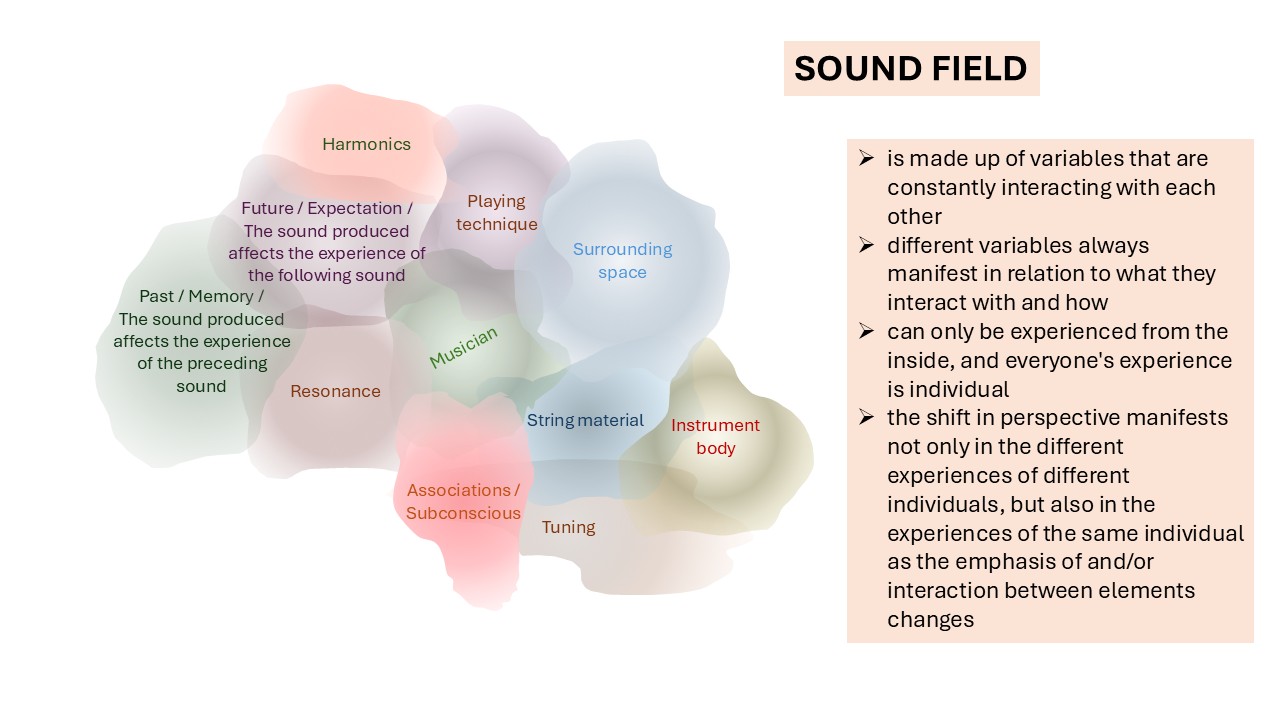
The human touch, with its conscious and unconscious modifications in strength, choice of plucking finger, finger angle, and plucking point, for example, is one of the variables within the sound field. In other words, human fingers are seen as part of the instrument and thus the human touch is one of the components constructing the timbre. Even small changes in these parameters can produce distinct timbral shifts. In acoustic research this can be seen as a hindrance to reliable analysis, but from the perspective of the instrument’s musical background, embedded in its cultural history, it is regarded as an essential element of the timbre.
Because the strings are plucked upward and rarely stopped, they resonate freely with the sound box and structural components, producing a multidimensional sound field. By altering the plucking technique, the musician varies the timbre of this sound field, and the music unfolds as a long continuum of constant variation that can lead the musician into a trance-like state.
The resonance, with its varying harmonics, slowly grows through the sympathetic vibration of the open strings. The structural components of the instrument’s body contribute their own vibrational modes to the sound, and thus the resulting sound field is far more complex than merely the notes produced by the individual strings.
The old plucking technique, the tactile negotiation of strings, and the instrument’s resonant behaviour all act as agents in the unfolding of the music. In addition, resonance functions both as an acoustic phenomenon and as a conceptual tool, revealing how each sound carries traces of previous gestures and how improvisation becomes a dialogue between intention, materiality, and memory.
For Arja, the highligt of the trip will be the reunion with the flutist Alison Melville and the hurdy-gurdy player Ben Grossman.