
Sibelius Museum’s Large Kanteles
News
March 31, 2026
From 2014 to 2017, I photographed and measured all the kantele instruments at the Sibelius Museum in Turku. Information on the five‑string kantele and on small kantele instruments with more than five strings has been published previously. The third file, Sibelius Museum’s Large Kanteles, is now available at the bottom of the Research page. All files are in Finnish.
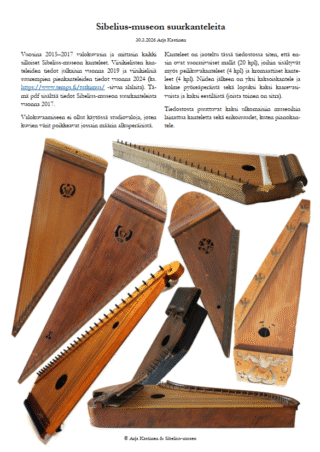 The file contains images of 27 instruments, along with structural and historical information. The kanteles are grouped so that the straight‑sided instruments come first (20 in total), including four mirror‑image kanteles (or “left‑handed” kanteles) and four chromatic kanteles.
After these, there is one double kantele made by Heikki Linjama, as well as three round‑ended, two curved‑sided, and two Estonian instruments (one of which is a zither).
Although no information can be found on the origin of some of the kanteles, the large kanteles in the Sibelius Museum form an interesting compilation of the different developmental models of the instrument from the late 19th century to the 20th century.
The collection includes not only instruments by well‑known kantele builders (Juho Tamminen, Paul Salminen, Efraim Kilpinen, J. E. Engström, Heikki Linjama), but also models made by private individuals who devoted themselves to kantele building.
Some kanteles have retained features of the old carved instruments, such as the fan‑like radial arrangement of the strings, the downward‑curving ponsi, and the spiral at the tip. The SM125 kantele even has a varras—the metal bar used for string attachment—placing the instrument somewhere between the small and large kantele types.
The surface treatments of the kanteles are highly varied, in some cases even innovative, and the color tones differ widely.
The internal structures feature a range of solutions and experiments, including various top‑ and bottom‑bar constructions. The SM1581 kantele, possibly built by Antti Auvinen from Pielavesi, even includes a partition wall.
The round‑ended models are also of interest, and among them at least one was apparently made in Southwest Finland. The large kanteles in the Sibelius Museum offer a rather diverse picture of the kantele tradition in Southwest Finland.
The file now published does not include innovations in instruments that are named after kanteles but were developed as entirely new instruments, such as the piano kantele designed by Juhani Pohjanmies (manufactured by Osakeyhtiö Kantele, Jyväskylä, No. 00023) and the unique upright, large rectangular “kantele zither” (SM712) built by Kustaa Grönlund.