
Echoes of Valamo
Church Bell Imitations in Karelian Kantele Tradition, Past and Present
 [This is an English translation (spiced up with additional photos) of the article by Arja Kastinen: Valamon kellot – Karjalaisten kanteleensoittajien kirkonkelloimitaatioiden tausta ja merkitys ennen ja nyt, which was published in the book Sivuutetut soinnit: Näkökulmia musiikin historian tutkimukseen Suomessa on 18 December 2025 (ed. by Kaarina Kilpiö and Saijaleena Rantanen, pp. 259–299).]
In the remote regions of eastern Finland and Karelia, information was recorded in the late nineteenth and early twentieth centuries about a musical tradition that had already vanished elsewhere in Finland by that time. A major transformation in the musical culture of Finnish- and Karelian-speaking communities had begun in western Finland in the seventeenth century, spread to Savo in the late eighteenth century, and finally reached Karelia in the nineteenth century. This transformation entailed a shift from runosong culture¹ to verse singing, accompanied by the adoption of new instruments and the rise of fiddler music. (Asplund et al., 2006, p.12.)
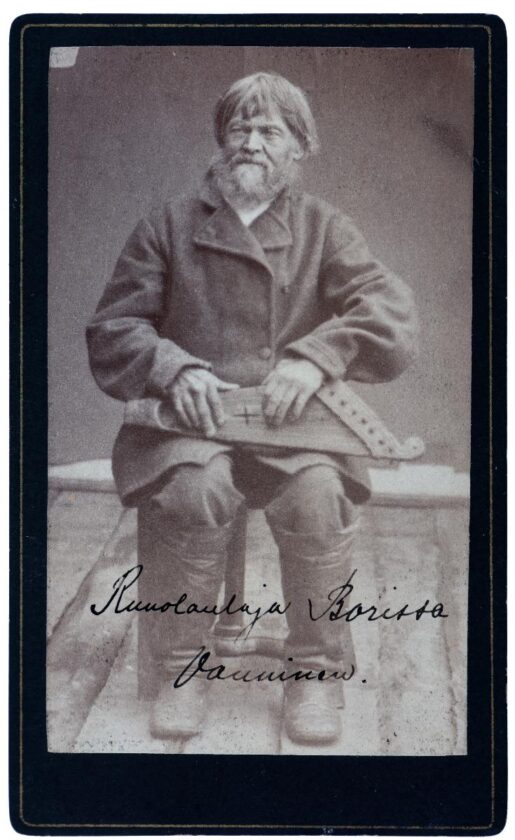
Ontrei Borissa Wanninen. “The last known runosinger in Sortavala”. Photo: Knut Sallin, 1885. The Finnish Heritage Agency, Historical Picture Collection, finna.fi.
The most important instrument within the runosong tradition was the archaic carved kantele. Around the turn of the twentieth century, masters of this aural tradition were “discovered” and idealised in the spirit of national romanticism, becoming also sought after by collectors. At the time these materials were documented, old-style kantele music was associated particularly with the northern areas around Lake Ladoga in Karelia. The cultural diversity of this region in earlier centuries—especially in relation to neighbouring western and southern areas and to the rest of Europe—is evident.
The development and preservation of regional cultural differences in Finland were shaped by variations in climate and soil, which made a hunting‑and‑fishing economy more viable than agriculture in the east and north. According to recent ancient DNA studies, the border established by the Treaty of Nöteborg (the Peace of Pähkinäsaari) in 1323 reflected an earlier division between western and southern farming populations and eastern and northern hunter‑gatherer groups—a division still clearly visible in the genetic heritage of the Finnish population (Palo 2020; Korpela 2008, pp. 40–45).
In the challenging and sparsely populated Karelian wilderness hunting and fishing remained the primary means of livelihood for centuries, supplemented by small‑scale slash‑and‑burn agriculture. Even at the beginning of the twentieth century, a similar contrast persisted between the farmers along the Lake Ladoga coast and the inhabitants of the more remote northern Karelian backwoods (Brander 1928, pp. 51–58; Hämynen 1993, pp. 41–43). In addition to extended fishing and wilderness expeditions, men in these areas earned extra income by transporting goods (often by horse and sledge) and other seasonal work, but communal life largely remained centred on the village and family (Hämynen 1993, p. 148; Siikala 1990, p. 26).
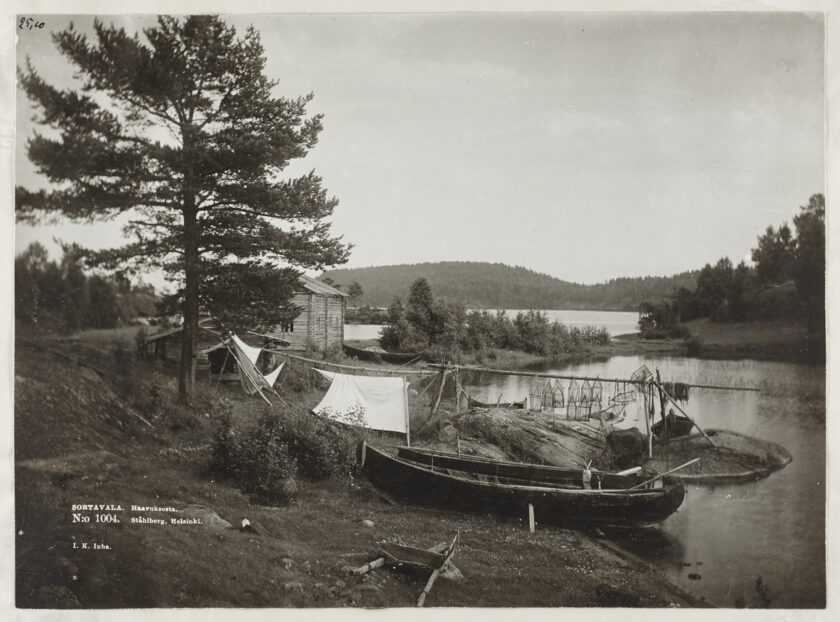
A fisherman’s cottage in Haavus, the rural munincipality of Sortavala. Photo: I. K. Inha 1895. The Finnish Heritage Agency, Ethnographic Picture Collection, The Collection of the Karelian Student Nation, finna.fi.
A different way of life was also reflected in musical culture. In the runosong tradition of the northern regions, the epic repertoire—transmitted primarily as a male tradition—was more archaic and mythic than the songs of South Karelia, Ingria, and Estonia, or those of the more western Finnish areas. According to the folklorist Anna‑Leena Siikala (1943–2016), the northern epic “resembles in many respects more the tradition of non‑written cultures outside Europe than the tradition of European folk cultures”² (Siikala, 1990, p. 19; Siikala, 2014, pp. 112, 135). Interestingly, the archaic carved kanteles preserved in Finnish museum collections reveal models that partly follow the Treaty of Nöteborg border: northern kanteles hollowed from below and open at the bottom, and southern kanteles hollowed from above or from the side, with the opening covered by a separate plate (Laitinen, 2010, p. 122).
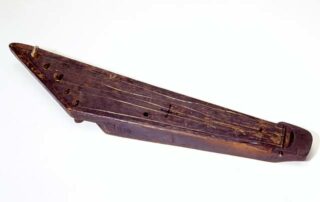
Runosinger Ontrei Malinen’s kantele from Viena Karelia, 1833. Hollowed out from below. The National Museum of Finland, finna.fi.
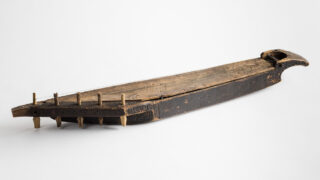
A five-string kantele from Kurkijoki, Ladoga Karelia, 1698. Hollowed out from the top with a separate top plate. The National Museum of Finland, finna.fi.
At the end of the nineteenth century, the social and cultural differences between Finnish peasants and the ruling gentry were enormous. From the perspective of ordinary people in Karelia, the gap in knowledge and living standards was often even wider. Many of the old kantele masters recorded at the turn of the twentieth century were illiterate and poor, some even landless. Their musical worldview was grounded in the aesthetics of runosong culture, transmitted aurally across dozens of generations. Kantele music was improvised and continually varied over time. Its character was strongly shaped by a distinctive playing technique that appears to have been linked to runosong culture for centuries. Folk music researcher Armas Otto Väisänen (1890–1969) called this technique yhdysasentoinen näppäilytekniikka—an interlocking use of both hands along the scale, employing various fingering patterns and plucking the strings upward into the air (Väisänen, [1928] 2002, p. x). Only a small fraction of old‑style kantele music has been preserved, in the form of short, simplified notations, early twentieth‑century audio recordings, and written descriptions of performance situations. Among these recordings, church bell imitations stand out as a distinctive, albeit small, group.
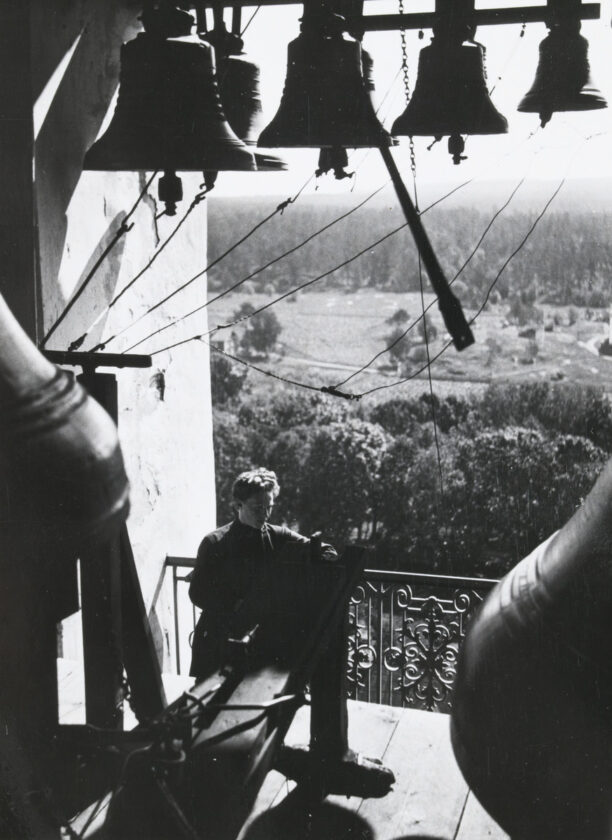
Valamo church bells, around 1930s. The Finnish Heritage Agency, Historical Picture Collection, finna.fi.
The title of the church bell imitations is often associated with Valamo (see Table 1). After outlining the general background of the tradition, this article therefore focuses on examining the connection between the Valamo monastery (or Valaam monastery) and Karelian kantele players. The Orthodox faith has been an important part of Karelian life for centuries. As part of my research, I consider the meanings that church bell imitations may reflect in relation to pilgrimages to Orthodox monasteries and to the position of the Orthodox Church within Karelian communities. The roots of the kantele tradition in question extend back centuries as part of runosong culture and are closely connected to mythical beliefs. I therefore also examine how folk religion and Christian Orthodoxy intertwined in the worldview of Karelian kantele players, whether church bell imitations can be understood as linked to traditional pre‑Christian belief system, and how far back in history the practice of church bell imitation may reach. In addition to contemporary literature and articles, the source material includes research in folklore, folkloristics, archaeology, and religious studies, as well as online materials. The most important unpublished primary sources are the kantele manuscripts and recordings preserved in the archives of the Finnish Literature Society (SKS).
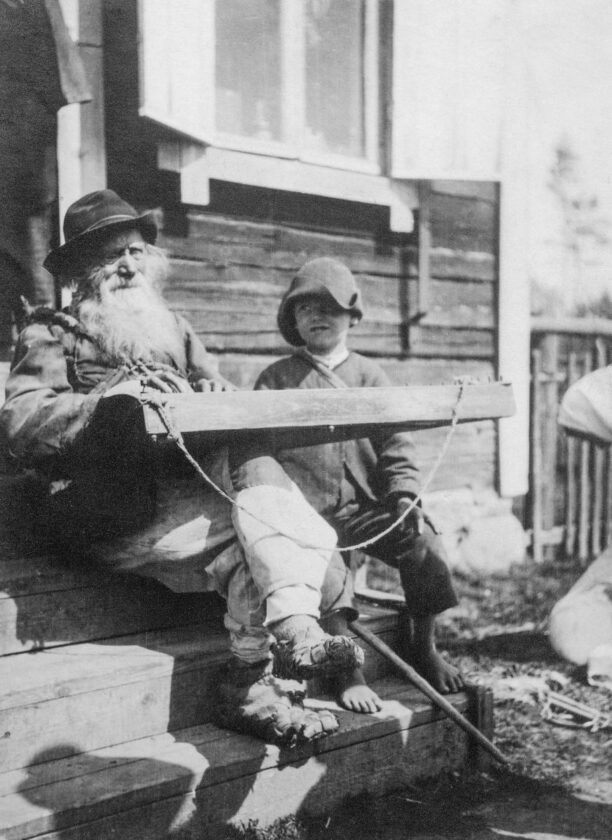
Teppana Jänis from Suistamo plays the Kantele on 3 June 1921. The Finnish Heritage Agency, Ethnographical Picture Collection, finna.fi.
I also approach the subject from within music, drawing on my own experience as a musician. From this perspective, I find the views of historians Pertti Haapala (born 1954) and Jorma Kalela (1940–2022) particularly relevant, especially regarding their treatment of temporal perspective and the researcher’s position. Rather than a linear concept of time that sharply separates the past from the present and the future, they propose a more fruitful notion of “oma aika”—“one’s own time”, which integrates all three temporal dimensions. The English historian Edward Hallett Carr (1892–1982) discussed this concept in his 1961 book What Is History? This notion encompasses all time—past and future—that an individual considers meaningful, without which the present would be incomprehensible. Haapala argues that historical research is the study of this “one’s own time”, in which the researcher is inevitably part of the research and cannot stand outside it. As Anna‑Leena Siikala has noted, our present situation continually shapes our ability to perceive the past; similarly, Haapala maintains that historical research is, in essence, “a researcher’s presentation of the social understanding of their own time”² (Haapala, 1989, pp. 10–12; Kalela, 2020, pp. 122–125, 132–138). Following Siikala’s example, my aim is to use insights gained from studying social context and cultural meanings to understand a tradition that has already receded (Siikala, 1990, p. 26). This aim includes not only the historical environment but also the knowledge produced through experiencing music in the present.
In the 1980s, new research on the traditional kantele and the revival of small‑kantele improvisation began under the leadership of Heikki Laitinen and Hannu Saha at the Finnish Folk Music Institute. This was accompanied by the “Kantele to School” project, which introduced a music education method based on creative music‑making and improvisation—an alternative approach at the time. The aesthetics of traditional kantele music were seen as offering equal opportunities for making music and creating one’s own music for everyone, regardless of musical background, age, or socioeconomic status. (Tenhunen, 2010, pp. 213–215.) As a product of that era, my own research is guided by a desire to understand the essence of this music, its meanings within the original context of the tradition, and its practical possibilities and contributions to modern societies, both now and in the future. Music‑pedagogical models based on the aesthetics of Karelian kantele improvisation are, in many respects, consistent with the principles of democratic dialogue. Furthermore, their contemporary musical philosophy aligns closely with the Capabilities Approach developed by philosopher Martha C. Nussbaum and economist Amartya Sen. This theory emphasises society’s role as an equal provider of opportunities to all its members, taking into account their starting points and respecting individual autonomy. (Nussbaum, 2013, pp. 17–19; Sen, 1999, pp. xii, 53, 85–86.)
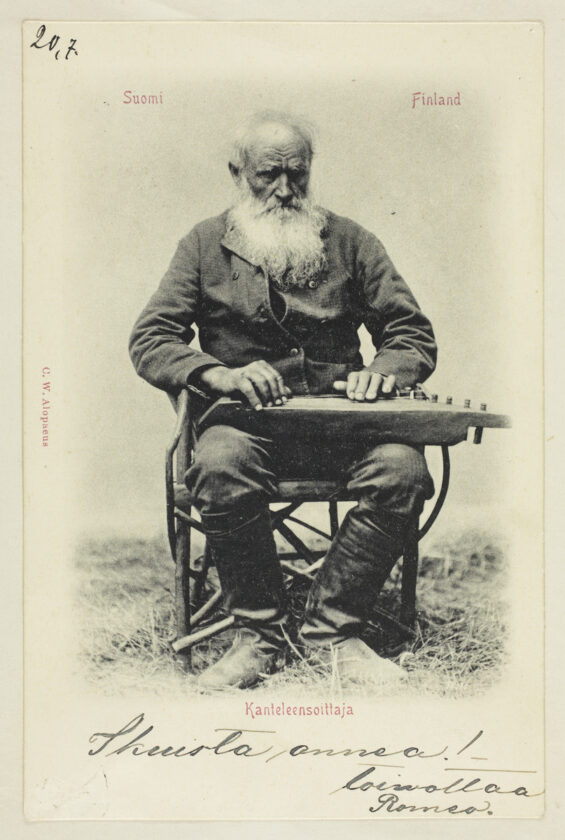
Pedri Šemeikka, Mysysvaara, Korpiselkä. The picture was published by C. W. Alopaeus in 1903. The Finnish Heritage Agency, Ethnographic Picture Collection, finna.fi
In this article, I focus on a specific aspect of the kantele tradition that I have studied: church bell imitations. Exploring the music of a bygone era requires integrating knowledge from several disciplines with musical performance. In the case of the traditional kantele, these include cultural history, folklore, archaeology, and organology, as well as brain research when connected to the improvisational event itself (see, for example, Kastinen, 2021). Achieving genuine understanding necessitates critically examining existing source material: what can recordings from a hundred years ago tell us about the instrument and the recording situation, and what do they leave out about the tradition bearer? Moreover, each musician’s experience is—and has always been—unique, regardless of time. As Jorma Kalela has stated, “In empirical research, many pasts are always present because each person has their own unique life course”² (Kalela, 2018, p. 35). The life courses of most Karelian kantele players are now lost to history.
The Encounter Between Ancient Kantele Music and Modernity
Since the revival of the Karelian kantele tradition in the 1980s, it has become evident in countless workshops and playing situations that creating music with the old plucking technique is initially a disorienting experience for a modern player accustomed to notation‑based music making. Professional musicianship or previous music studies may even pose additional challenges, as practices grounded in Western musical thinking must be “reset” both in terms of technique and aesthetic orientation. For those who think in relation to the musical staff, the instrument appears to be “the wrong way around,” with the shortest string—i.e., the highest pitch—closest to the player. In older manuscripts, the tuning of the instrument often does not correspond to the key of the written notation; instead, the music is transposed according to the instrument at hand. Alternating between the right and left hands along the scale with different fingering options can feel counterintuitive, and the technique requires considerable repetition before the brain accepts the idea of interlacing the fingers. As with other instruments and playing techniques, achieving a level of automatic motor activity is essential if the player wishes to focus on the music itself rather than on the movements of the fingers.
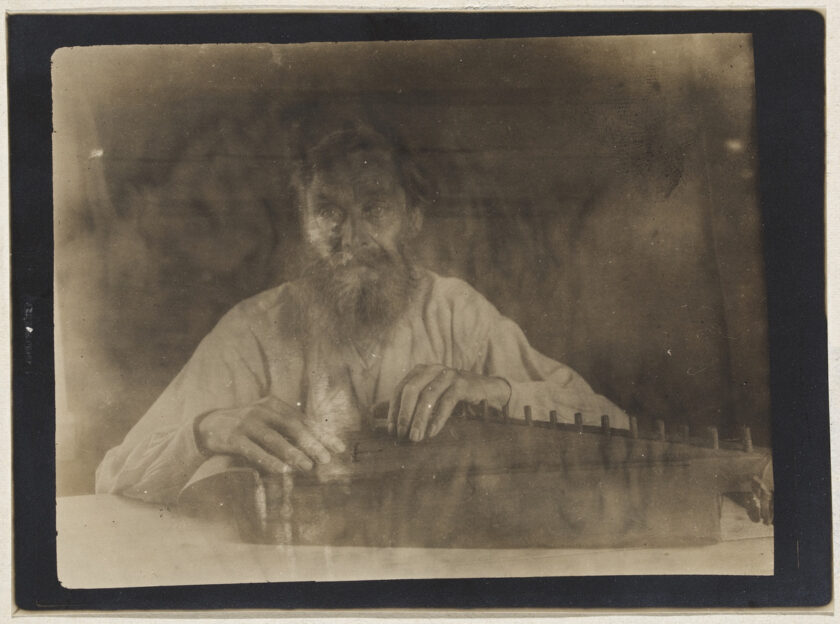
Hilppa Vornan (Antero Vornanen’s father), Ristsalmi, Korpiselkä. Photo: A. O. Väisänen, 1910s. The Finnish Heritage Agency, Ethnograåhic Picture Collection, finna.fi.
After this, the player must internalise the idea that the music is in constant transformation, shaped over time by the musician’s own associations. Written transcriptions—often only one‑ or two‑line verses—are merely hints of the musical narrative that once unfolded in performance. The notation rarely includes accompanying tones, let alone variations, even though the polyphonic nature of kantele music was self‑evident to everyone. The use of time signatures that were not part of the original music, and the resulting placement of bar lines, can sometimes lead to misinterpretations of phrase structure. Archival recordings also show that rhythms have often been adapted to fit these time signatures in a simplified form compared to the original. Even the scale indicated in the notation does not represent an absolute truth: musicians historically—and still today—have the freedom to express the same musical idea at different times using different scales, according to their mood. Modern players must also remember that nineteenth‑century Karelian musicians of the aural runosong culture had never encountered the concept of equal temperament. As in sung music, the kantele employed not only major and minor thirds of varying sizes but also a neutral third. Thus, a profound gap exists between the notation we use today and the original music—just as there was a gap between the nineteenth‑century Finnish elite and the Karelians of the wilderness.
From a musical‑aesthetic perspective, one of the greatest challenges for people today is learning to be content with a narrow ambitus and the quiet sound of the instrument. Constant noise has become a normal part of our living environment, and we have grown accustomed to a vast palette of instruments in contemporary music. It may be difficult—if not impossible—for us to comprehend the scarcity of visual material and of music from outside one’s own community that nineteenth‑century Karelian commoners experienced. We have almost unlimited access to music from around the world, and modern sound reproduction makes it easy to drown out surrounding noise simply by amplifying the music. The equal‑temperament scale is now the norm in the entertainment industry, which permeates much of our lives, and the absence of chromaticism is easily perceived as a musical deficiency. Finnish society and culture have undergone a complete transformation in relation to the runosong culture of past centuries, and this shift is not unrelated to the parallels seen in encounters between Indigenous peoples and politically dominant cultures in various parts of the world (see, for example, Robinson, 2020; Siirala, 2024, pp. 43–51).
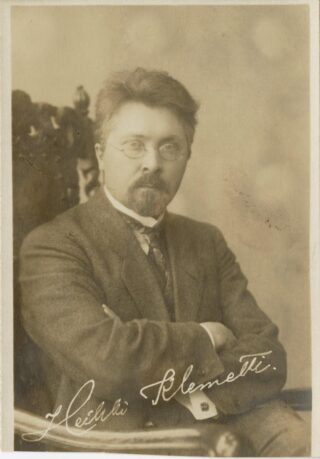
Heikki Klemetti, around 1905-1915. Sibelius Museum Archive, finna.fi.
The following example illustrates the contradictory attitude of the educated elite in early‑twentieth‑century Finnish musical circles toward Karelian kantele players, and shows how the challenge of interpreting musical notation remains relevant today. Everik Rähkönen (1824–1906), a kantele player born in Korpiselkä who later moved to Karttula, visited Helsinki in March 1905. There, the 29‑year‑old director of the Suomen Laulu choir, Heikki Klemetti (1876–1953), was captivated by Rähkönen’s performances of runosongs and kantele music, regarding him as a “representative figure of the old generation of sages.”² Klemetti wrote about Rähkönen in the Finnish music journal Suomen Musiikkilehti in 1935 and again in 1942; the latter article was also connected to the Greater Finland ideology. He praised Rähkönen as the most genuine and authentic representative of traditional kantele playing, and yet, “when Rähkönen’s fingers danced across the strings, as though Liszt or Paganini sprang to mind.”² Klemetti recounts how Armas Launis (1884–1959) was later sent to transcribe Rähkönen’s unique music, and how he himself was disappointed with the results: “With all due respect to Launis’s notation skills, the pieces were disappointing when I remembered Rähkönen’s excellent performances in nature.”² His frustration stemmed not only from the incompatibility between the notation and his own mental image of the music, but also from the absence of melodies: “When I used to listen to him for hours, there should have been many more.”² (Klemetti, 1935, pp. 50–52; Klemetti, 1942, pp. 4–6.)
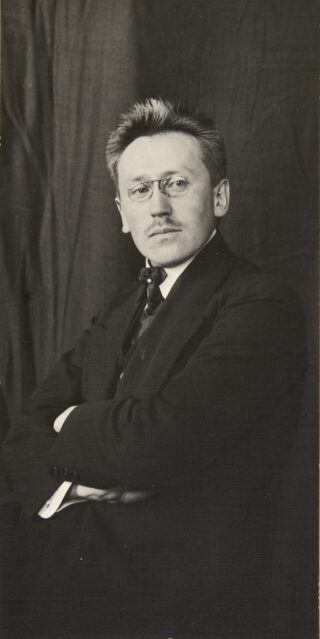
Armas Launis around 1910s. The Finnish Heritage Agency, Historical Picture Collection, finna.fi.
Launis himself wrote about his encounter with Rähkönen in almost the opposite tone in 1923. He claimed to have met Rähkönen in Karttula in early 1905, that is, before the events in Helsinki described by Klemetti. Launis was able to notate only three tunes, because “the old player’s other repertoire of tunes, which had once been extensive, had been completely forgotten”² (Launis, 1923, p. 227). The contradiction between the two accounts is reminiscent of an episode involving a kantele player from Olonets Karelia in 1882: after playing a few dance tunes for a group of enthusiastic explorers, he announced that he knew no more, yet later, in the peace and quiet of a corner of the room, he improvised for the entire evening (Relander, 1917, p. 20).
In Klemetti’s description, Rähkönen was taken around Helsinki, and when he received 75 Finnish marks for his performance at “Suomen Laulu’s big lottery with special programmes in Seurahuone 35”², he “fell flat on the ground and kissed the giver’s boot”² (Klemetti, 1942, p. 4). In Launis’s article, by contrast, “primitive folk music was of little value at that time”², and “this respectable representative of the land of runosong was allowed to play in a side room of the old Seurahuone amidst a rather varied programme of all kinds”² (Launis, 1923, p. 230).
Folklorist Kati Kallio has described how Launis’s interpretations were shaped by the widely accepted, supposedly legitimate, and superior values of Western art music. Over the course of his many field‑collecting trips among the Sámi, Karelians, and Ingrians, however, he gradually learned to understand the meaning of music also from the perspectives of the original cultures. As a cosmopolitan, he did not share the most fervent nationalist ideals of his twentieth‑century contemporaries (Kallio, 2012, pp. 13–16). This is evident in Rähkönen’s case: unlike Klemetti, Launis had no need to use him to support his own political ideology. His comments also contain criticism of the arrangements for the Seurahuone performance. Although both Klemetti and Launis considered themselves qualified to evaluate Rähkönen’s music, it is clear that neither knew Rähkönen—or the musical culture he represented—particularly well; Klemetti even got Rähkönen’s first name wrong (Tenhunen, 2013, p. 37).
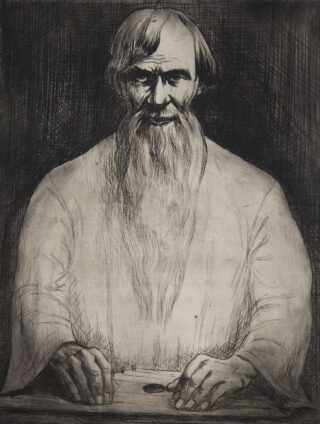
Toivo Talvi’s drawing, 1935: Ivan Bogdanoff playing the kantele. North Karelia Museum, Ladoga Karelian Museum items, finna.fi.
In the summer of 1905, when—according to Klemetti—Launis should also have been recording Rähkönen’s playing, he was in fact in Border Karelia as a fellow of the Finnish Literature Society, collecting runo melodies. In Suistamo, he met four kantele players named Iivana: Iivana Šemeikka (also known as Jehkin Iivana, 1843–1911), Ivan Bogdanoff (c. 1843–1911), Iivana Mišukka (1861–1919), and Ivan Härkönen (1854–1928) (SKS KRA, Armas Launis’s melody manuscripts, 1905). In his 1905 article in Finsk Musikrevy, Launis warmly describes his visit to Iivana Šemeikka’s home, noting that Šemeikka was “a real virtuoso” compared with other kantele players. He also remarks, however, that the music of the five kantele players he had recorded up to that point was so similar that the differences were difficult to discern without careful notation. (Launis, 1905, pp. 262–263.)
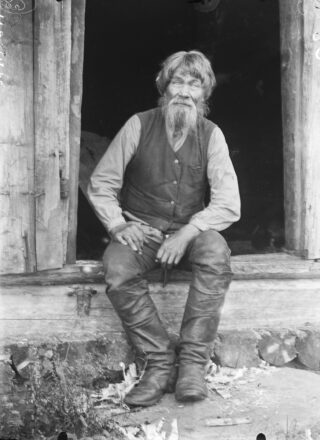
Iivana Šemeikka. Photo: Samuli Paulaharju, 1908. The Finnish Heritage Agency, Ethnographic Collections, finna.fi.
Launis was particularly critical of the dance tunes—which already represented a younger musical stratum—judging them melodically and harmonically simple. In his view, their interest lay primarily in rhythmic variation. Yet the modest melodic material was compensated for by the fullness of sound created by the long reverberation of the tones, “which, for example, a square piano cannot even remotely reach”². Launis transcribed church‑bell imitations from Šemeikka, Mišukka, and Rähkönen, which he categorised as känslostycke—”atmospheric tunes”—within the kantele repertoire. Unlike the dance tunes, he believed these pieces were individually constructed and aptly evoked the sound of Russian church bells. (Launis, 1905, pp. 263–264.)
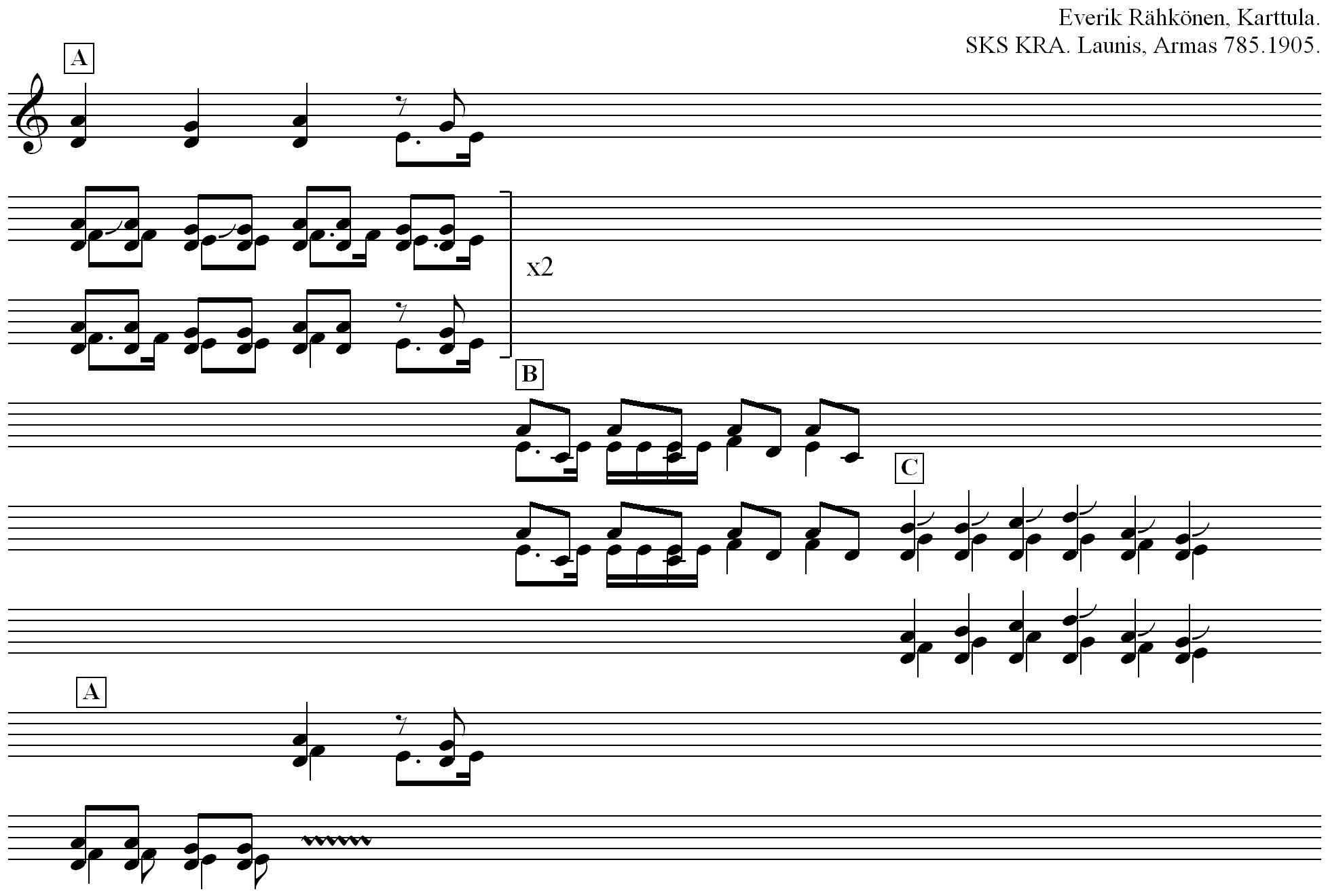
It is probably unjustified to blame Launis for simplifying the kantele manuscripts, as they corresponded to the folk‑music recording principles of his time to some extent (Kallio, 2012, p. 7). Unlike other collectors, he notated kantele motifs—played with the old plucking technique, where both hands alternate along the scale—on two staves, left and right, as in piano notation (Example 1).
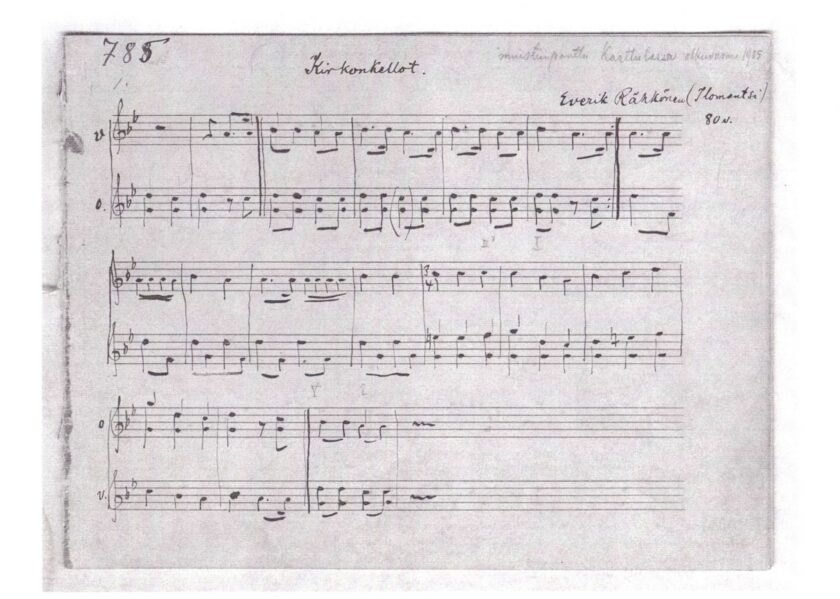
Example 1. Armas Launis’s manuscript from Everik Rähkönen’s Church Bells. SKS KRA, Launis, Armas 785. 1905.
The manuscripts use a G‑based scale, meaning that they do not indicate the original pitch. The melodies notated from Rähkönen appear in a Dorian‑like scale, which Klemetti (1942, p. 6) interpreted as evidence of medieval roots. (The Dorian mode is part of a scale system theorised in European monasteries and churches during the Middle Ages, although several of these scale types had been in use long before the modal system was formalised.) Without mentioning the Dorian mode, Launis (1923, p. 230) notes that Rähkönen’s minor tuning was unusual compared with the major or neutral thirds used by other players. He also remarks that Rähkönen altered the scale, which he suspected might have been due to poor hearing.
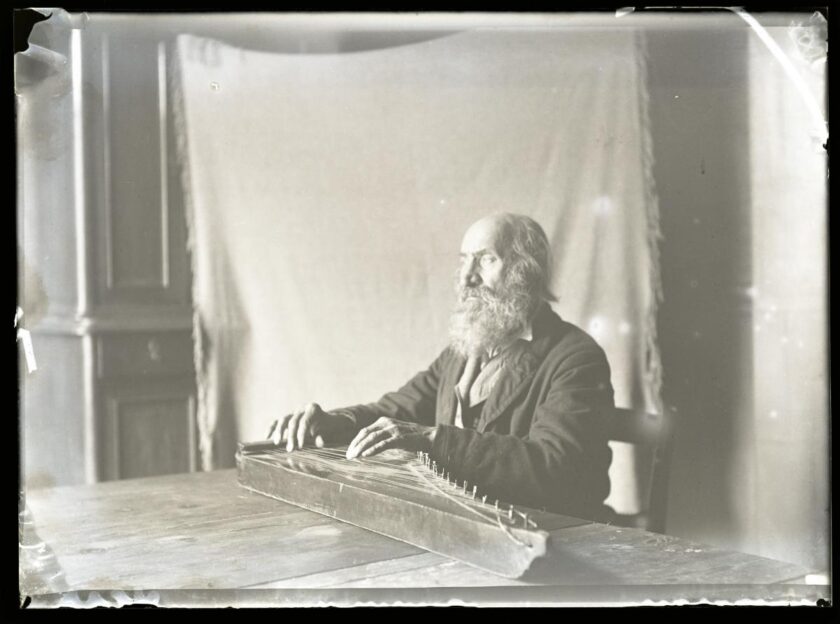
Everik Rähkönen. Photo: Ludvig Fabritius, 1897. Sibelius Museum, finna.fi. In this picture, instead of the traditional carved kantele, Rähkönen plays a kantele made of several pieces with metal tuning pegs. This instrument represents the change in musical culture.
Regarding Rähkönen’s church‑bell melody, Launis (1923, p. 228) notes in a footnote: “It should be noted that the opening bars of this piece provided the starting point for the Kullervo opera’s tune ‘Kaks oli meitä kaunokaista’”². According to Kati Kallio (2012, p. 6), Launis had previously mentioned that the Kullervo opera was based on Ingrian shepherd and runo melodies, which he partly perceived as Russian. In his book Hungry Listening: Resonant Theory for Indigenous Sound Studies, Dylan Robinson (2020, p. 8) examines precisely this kind of problematic situation in which Indigenous music functions as a resource for art music without challenging the performance norms of concert music or the ontologies of music‑making—its meaning reduced to “an ingredient in someone else’s stew”.
Although Launis also describes the common people he encountered with respect, the power structure is unmistakable. Even today, it is not always recognised that ethical issues may arise when drawing on the music of old kantele players, or that in its original context the music may have carried deeper ontological meanings beyond serving merely as aesthetic material or entertainment.
The deeper we delve into ancient kantele music, the more impossible it seems to capture it through musical notation. Attempting to approach the music of a Karelian kantele player from more than a century ago through the surviving manuscripts poses an ethical challenge similar to the one described by Dylan Robinson: “No language or writing form is value free. Forms of structural music analysis, for example, enact epistemic violence against Indigenous music, blunting the life it carries” (Robinson, 2020, p. 83). Raised within the rules of Western music theory, we find it difficult to accept and perceive the essence of freely unfolding music. Alienated from the ontology of music in its original culture, we cling to elements that are, from that perspective, almost absurd—time signatures, keys, or individual notes on a stave. The true freedom of rhythmic and pitch transformation is hard to grasp. What remains for us is merely a blurred snapshot of a moment, surrounded by a spectrum of indistinct details and an endlessly varying flow of music intertwined with its cultural meanings.
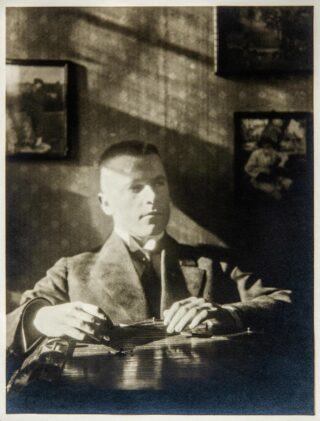
A. O. Väisänen playes the kantele. Self-portrait in 1920(?). The Finnish Heritage Agency, Historical Picture Collection, finna.fi.
A. O. Väisänen, who was also a student of Launis, reflected on the discrepancy identified by Klemetti and Launis between the sound field produced by the kantele and the simplicity of musical notation when preparing his own manuscripts. He experimented with separate note stems, as Launis had done, and with writing notes and slurs in red to indicate tones that stood out and resonated for a long time as part of the sound field (SKS Archive: SKS KRA Väisänen, A. O.; Launis, 1905, p. 264). (He also experimented with using two staves in some of his field manuscripts; see SKS KRA Väisänen, A. O., case 12, booklets 9:746 and 7:653.)
However, in the 1928 edition of Kantele- ja jouhikkosävelmiä, the notation was simplified: the colour markings and separate stems were omitted, and the tonic of all tunes was standardised to G4. The musical notations are condensed representations in which versions from different playing sessions were combined, and beat‑level variations were recorded in footnotes. (Väisänen [1928] 2002, pp. xv, xviii.)
In search of a more illustrative transcription method, I have used the paradigmatic presentation found in the musical examples of this article. This approach omits time signatures and bar lines (Example 2). The aim is to break away from predetermined structures, present variations as examples, and open up space for the player’s own choices. Nevertheless, the epistemic violence highlighted by Robinson remains present if the notation is interpreted through a completely inappropriate lens.
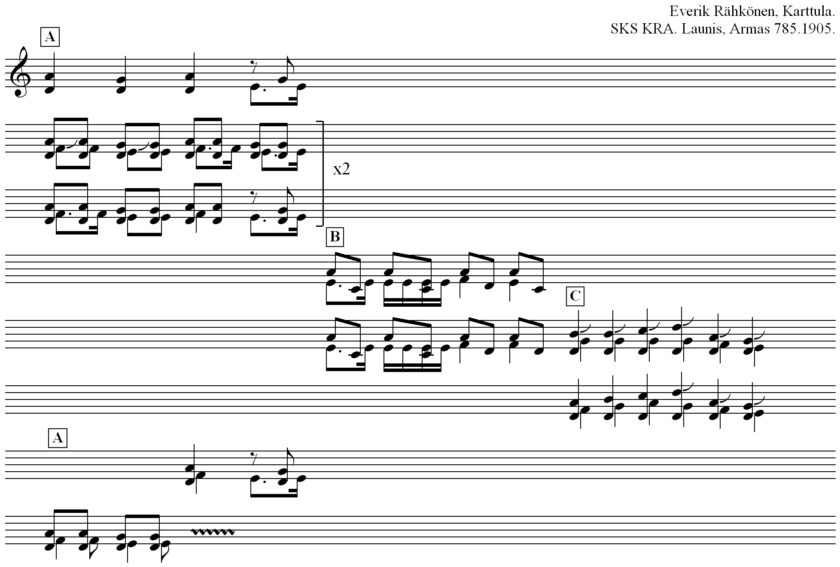
Example 2. My paradigmatic notation of Everik Rähkönen’s Church Bells. Notes played with the right hand have stems that point upwards. Notes that are marked with a separate stem by Launis, and which remain strong in the aural image for a long time, are marked with short upward arcs.
Karelians and Valamo
The origins of the archaic carved kantele and the Valamo Monastery are shrouded in myth and uncertainty. Both are integral to Karelian history, and both underwent profound transformations during the first half of the twentieth century. The old kantele tradition disappeared from the territory of the Finnish state with the decline of runosinging, while the Valamo Islands were ceded to the Soviet Union as part of Karelia following the Continuation War.
The Valamo archipelago consists of around fifty islands located in the northern part of Lake Ladoga, just over forty kilometres south of Sortavala. According to archaeologist Valter Lang, the areas surrounding Lakes Ladoga, Onega, Ilmajärvi, and Peipus were first inhabited by peoples descended from the Western Uralic Sámi branch (Lang, 2020, pp. 327–328). The Finnic Ladogan proto-language began to form no earlier than the eighth century (Kallio, 2014, pp. 163–165). Archaeological research (Uino, 1997, p. 204) indicates migration from Western Finland and Häme to the Karelian Isthmus during this period, a development that aligns with folklorist Matti Kuusi’s (1963, pp. 216, 230) dating of the runosong about the mythical origins of the kantele in his stylistic period theory. According to current understanding, the Karelian language emerged from the fusion of the indigenous population and incoming settlers on the northwestern shore of Lake Ladoga, while the Vepsian language developed on the southeastern shore—both deriving from the Proto‑Ladoga language (Lang, 2020, p. 322).
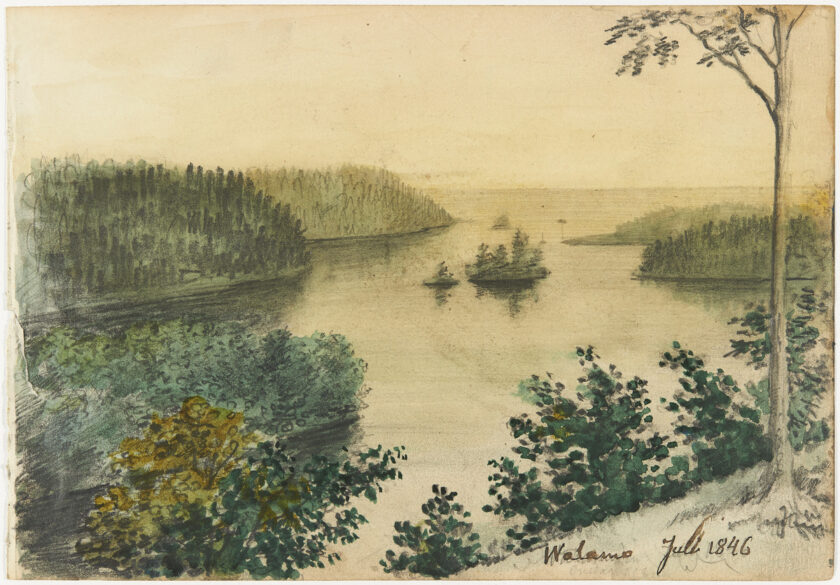
View from the Valamo Islands. August Fredrik Soldan, 1846, watercolor. The Finnish Heritage Agency, Historical Picture Collection, finna.fi.
The Sámi and Finnic tribes living around Lake Ladoga in the late first millennium practised shamanistic religions (Laitila, 2017, pp. 43–44; Siikala, 1999, pp. 16–19). The creators of the earliest heroic songs in the runosong tradition are likewise believed to have belonged to a shamanistic culture (Haavio, 1950, pp. 102–103, 309–310; Siikala, 1990, p. 19; Siikala, 1999, pp. 14–15). Several islands in Lake Ladoga are known to have hosted cult centres associated with ethnic folk religion, and these places were sacred to local inhabitants long before the arrival of Christianity.
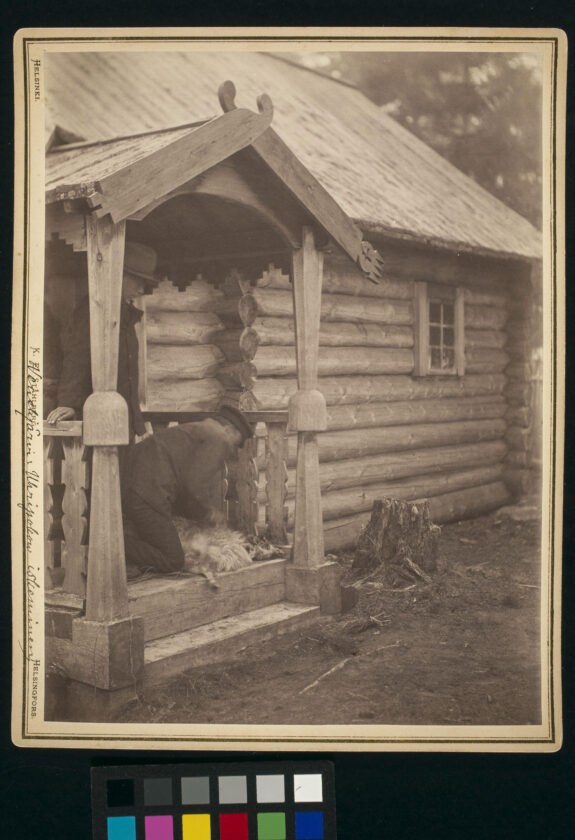
A man stabs a sacrificial ram to death and pours the blood under the steps of a tsasouna, a village chapel. Venehjärvi, Viena Karelia. Photo: I. K. Inha, 1894. Finnish Literature Society, finna.fi.
Mantsinsaari, near the Valamo Islands, had a tradition of bull sacrifices, while Lunkula Island was associated with ram sacrifices. The folklore of Konevits Island—located closer to the Karelian Isthmus and later home to a monastery—speaks of horse sacrifices. As late as the nineteenth century, an annual bull festival was held in Suistamo on Elijah’s Day (20 July) during the praasniekka, the memorial and feast day of the local patron saint. The householder on duty slaughtered a bull, the meat was cooked in a large pot in the old spruce forest cemetery, and it was served to the praasniekka participants after the service. Religious scholar Hannu Kilpeläinen considers the theory possible that the name Valamo is connected to the ancient Slavic god of death and cattle, Volos. Communities in the Ladoga region functioned as cult communities that influenced one another—mini‑religions that gradually incorporated elements of Christianity. For this reason, the significance of the Valamo archipelago presumably did not change dramatically for local inhabitants when it entered its Christian monastic era. (Kilpeläinen, 2000, pp. 125–134; Laitila, 2017, pp. 103–104; Rajamo, 1944, p. 272.)
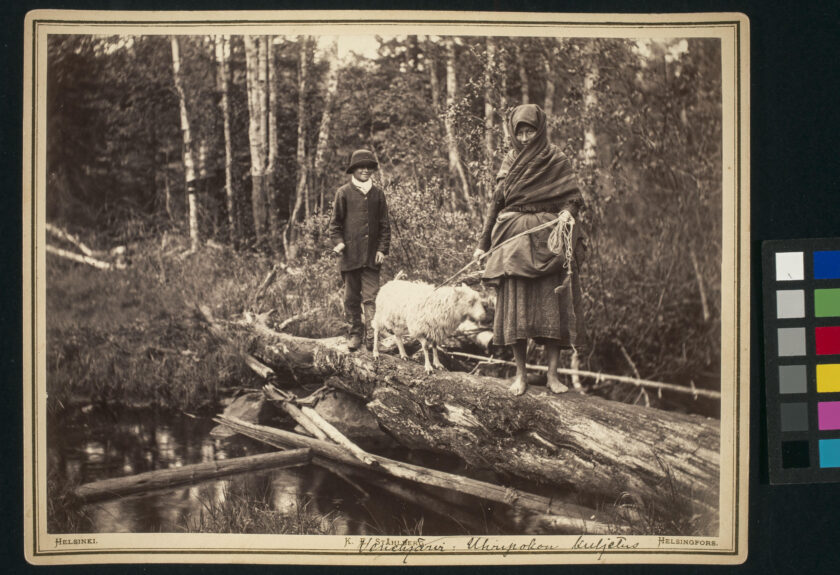
A woman and boy carry a ram for sacrifice, Venehjärvi, Viena Karelia. Photo: I. K. Inha, 1894. Finnish Literature Society, finna.fi.
The Karelians are first mentioned in Russian chronicles in 1143, while the earliest reference to Karelia appears in a Novgorod birchbark letter dated between 1065 and 1085. The Karelians practised agriculture, cattle breeding, hunting, fishing, and the fur trade, and they maintained extensive cultural connections throughout their surroundings. Evidence suggests that the Ladoga Karelians were in contact with Christianity as early as the Viking Age, with Christian artefacts being transmitted further into Karelia via Novgorod and Aldeigjuborg (Finnish: Laatokanlinna; Russian: Ladoga). Over time, elements of Christian teaching merged with the Karelian ethnic folk religion. (Huovila, 1995, pp. 28, 32–33, 40–41; Laitila, 2017, pp. 54–62; Lang, 2020, p. 324; Saksa, Uino & Hiekkanen, 2003, pp. 316–320, 354–357, 381–385, 438–440.)
It is assumed that the Sámi began retreating from the Ladoga area toward the north no later than the thirteenth century, under pressure from Karelian and Vepsian settlers, and that over the centuries they partly assimilated into Finnic population groups (Kuzmin, 2013, pp. 69, 98; Pöllä, 1995, p. 35). According to the Russian chronicle, almost all Karelians were baptised in 1227, and Karelia was annexed to Novgorod in 1278. However, historian Kati Parppei argues that the east–west burials that became widespread in the thirteenth century indicate the consolidation of ecclesiastical power structures rather than changes in belief systems. This interpretation is supported by documents from later centuries. (Kirkinen, 1994, p. 48; Laitila, 2017, pp. 61–67; Parppei, 2023, p. 72.)
Opinions on the date of the foundation of the Valamo Monastery vary, with estimates ranging from the twelfth to the early fifteenth century (Kilpeläinen, 2000, pp. 112–118, 130; Kirkinen, 1994, p. 54; Laitila, 2017, pp. 93–95; Lind, 1994, p. 34; Parppei, 2023, p. 79). Over the centuries, the monastery experienced periods of both prosperity and devastation as a result of wars and border conflicts between Sweden and Russia. Monastic activity ceased for more than a hundred years following the Peace of Stolbova (1617), when Käkisalmi County came under Swedish rule (Kilpeläinen, 2000, p. 146; Huovila, 1995, pp. 50–60, 85).
The population of Käkisalmi Karelia also changed significantly in the seventeenth century. By the middle of the century, it is estimated that approximately 25,000 Orthodox Karelians had fled to Olonets Karelia, with additional migration to Viena and Tver Karelia. After the War of Rupture (1656–1658), the region was almost entirely devoid of Karelians. The areas they left behind were settled by Lutheran populations, particularly from Savo and Vyborg Karelia. According to historian Tapio Hämynen, Border Karelia was almost the only area where part of the original population remained. From 1661 onward, some of those who had fled to Russia returned to their former places of residence. (Hämynen, 1993, p. 47; Laasonen, 2005, pp. 113–117; Pöllä, 1995, pp. 48, 56, 167, 316.) In other words, the areas from which information about the old kantele tradition was recorded at the turn of the twentieth century had also preserved their old Karelian population.
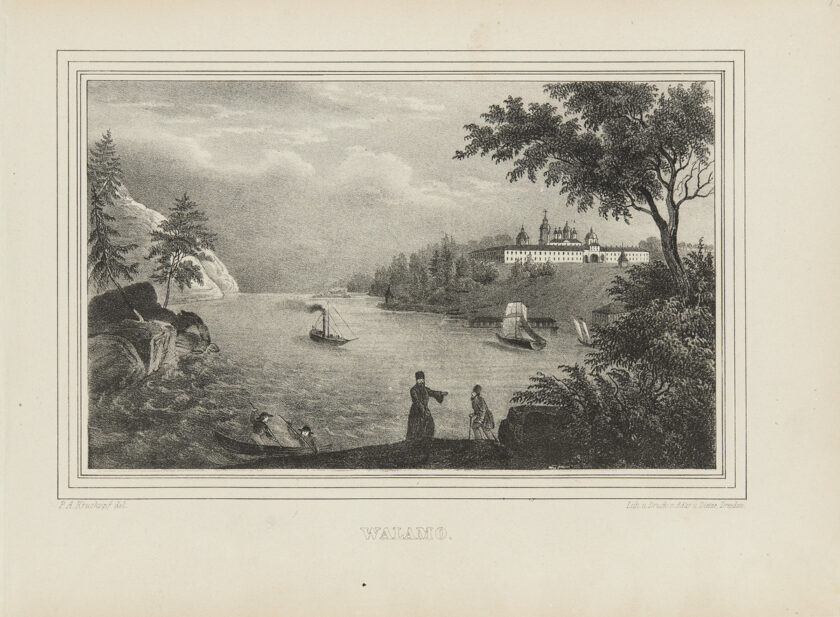
Valamo. Pehr Adolf Kruskopf, 1845-1852. Litograph. The Finnish Heritage Agency, Historical Picture Collection, finna.fi.
Following the Great Northern War (1700–1721), Käkisalmi County once again came under Russian control, and the Valamo Monastery was reconsecrated as early as 1719. Most of the monastery’s inhabitants were Russian, and it sought financial support from both ecclesiastical and secular authorities, as well as from wealthy Russian patrons. The Valamo Monastery developed into a centre of ascetic training and missionary activity, and the Karelian region was no longer among its primary areas of interest. (Huovila, 1995, pp. 85, 94; Kilpeläinen, 2000, pp. 146–149; Laitila, 2017, pp. 97–98; Parppei, 2023, p. 83.)
Nevertheless, the government made significant efforts to promote the revival of the Orthodox Church in the region. By 1764, Salmi had become predominantly Orthodox, while Lutheran settlements were concentrated in the Impilahti and Soanlahti areas (Huovila, 1995, p. 94; Hämynen, 1993, pp. 48–50). In 1822, Valamo was elevated to the status of a first‑class monastery by the Russian state. This rise in prestige brought increased funding and a larger monastic community, enabling the development of religious life. Regular steamship traffic began from the city on the Neva in 1857, and three years later from Sortavala to St Petersburg via Valamo. As transport connections improved and the monastery’s spiritual reputation grew, the number of pilgrims continued to rise in the late nineteenth century. (Kilpeläinen, 2000, p. 150; Laitila, 2017, p. 99.)
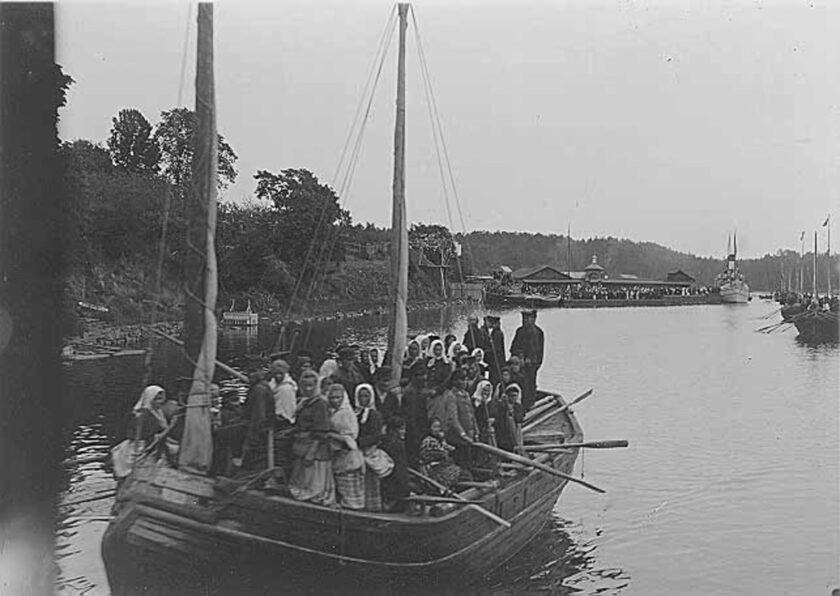
Karelians returning from Valamo. Photo: T. H. Järvi 1909. The Finnish Heritage Agency, Ethnographic Picture Collection, finna.fi.
At the turn of the nineteenth century, women and children were gradually permitted to visit the monastery island. Among the Karelians, the practice of jeäksiminen—that is, fulfilling a sacred vow, for example by making a pilgrimage to a monastery—became widespread in the second half of the nineteenth century. In addition to pilgrims and tourists, people in need also came to the monastery, including thousands of beggars during years of severe famine. The monastery provided assistance in the form of shoes, clothing, food, medicine, seed grain, and hay. Pilgrims received free accommodation and meals for several days. For the Karelians living near the Valamo Islands, the monastery also offered employment and opportunities for trade. (Kilpeläinen, 2000, pp. 153, 313–351; Parppei, 2013, pp. 110–113.)
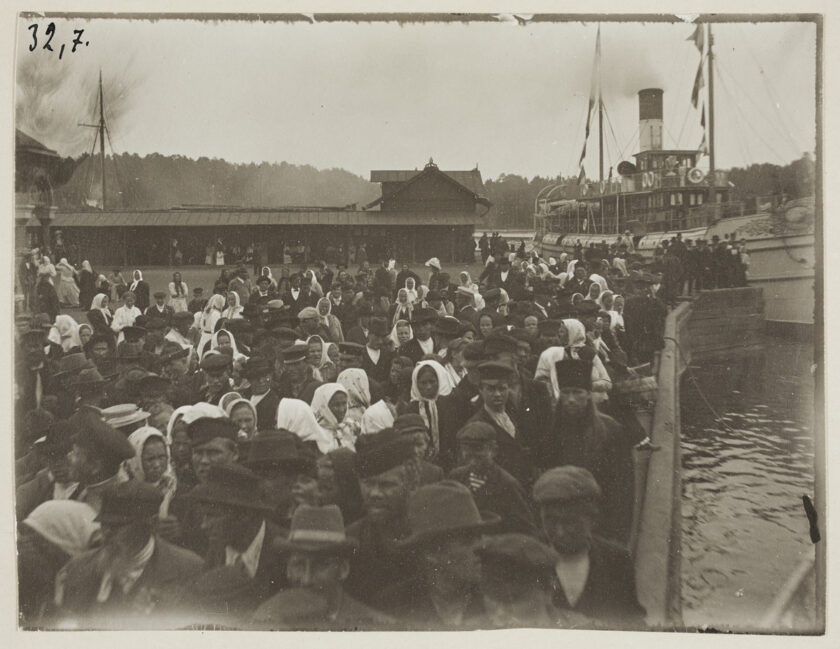
Crowded at the port of Valamo. Photo: V. Jääskeläinen 1908(?). The Finnish Heritage Agency, Ethnographic Picture Collection, finna.fi.
The Valamo Monastery lost its connections with the Russian Church and its major Russian donors when Finland gained independence and the Russian Revolution and the fall of the Russian Empire took place in 1917. By decree in 1918, the Orthodox Church became the second state church in Finland. Administratively, its affiliation with the Moscow Patriarchate ended in 1923, when it was canonically transferred to the Ecumenical Patriarchate of Constantinople. From that point onward, the monastery’s institutional ties were directed toward Finnish authorities, while its pastoral and missionary activities focused on the Karelian population on the Finnish side. Although the first Finnish‑language liturgy had been held in 1895, regular Finnish‑language services were not introduced until the 1930s. (Kilpeläinen, 2000, pp. 159–160, 265–267, 272; Laitila, 2017, p. 101.)
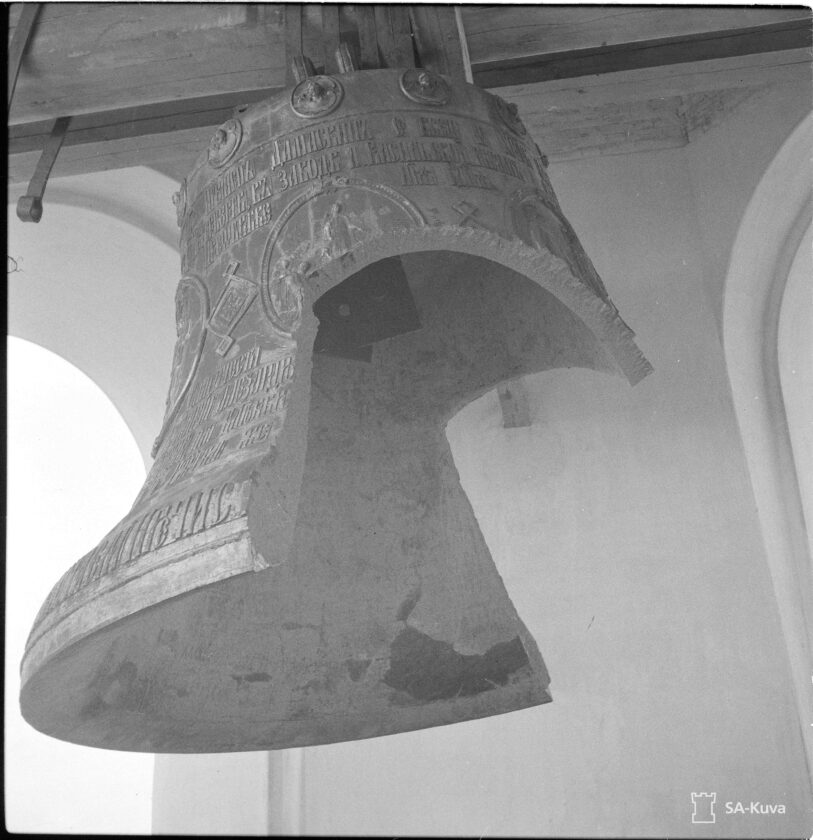
The bell of Apostle Andrew in the tower of the Valamo Monastery church during the Continuation War in 1942. Photo: M. Aaltonen. War Museum, finna.fi.
After the Winter War and the Continuation War, the Valamo islands were transferred to the Soviet Union along with Border Karelia. The monastery was evacuated in 1940, and the community relocated to the New Valamo Monastery in Papinniemi, Heinävesi, Finland. Valamo on Lake Ladoga was used for both civilian and military purposes during the Soviet era, but it has since been returned to the Russian Orthodox Church and once again functions as a monastery.
Teuvo Laitila (2017, p. 101) suggests that the Valamo Monastery may have appeared foreign to the Karelians around Lake Ladoga until Finland gained independence. According to Kilpeläinen (2000, p. 149), the fact that Karelian ascetics sought out small, more familiar wilderness monasteries rather than the large Valamo and Solovki monasteries likewise indicates that Valamo felt foreign—if not as a place of pilgrimage, then at least as a setting for Karelian asceticism. When pilgrimage involved jeäksiminen, the monasteries of Olonets (Stroitsa, Monastery of the Holy Trinity) and Viena Karelia (Solovki) were often more popular among Border Karelians than Valamo, largely because of the long journey, which had to be made on foot (Kilpeläinen, 2000, pp. 245–246; Stark, 2002, pp. 158, 163).
Until the end of the nineteenth century, the monks of the Valamo Monastery were almost entirely Russian‑speaking, and services were conducted in Church Slavonic. As a result, Karelians had no opportunity to understand the priests. In the eighteenth and nineteenth centuries, the Karelians also had conflicts with the monastery, particularly concerning land ownership and fishing rights. Liquor was smuggled to the island, and in retaliation for these disputes, deliberate acts of mischief were carried out there. (Kilpeläinen, 2000, pp. 154, 346–351; Laitila, 2017, pp. 100–101.)
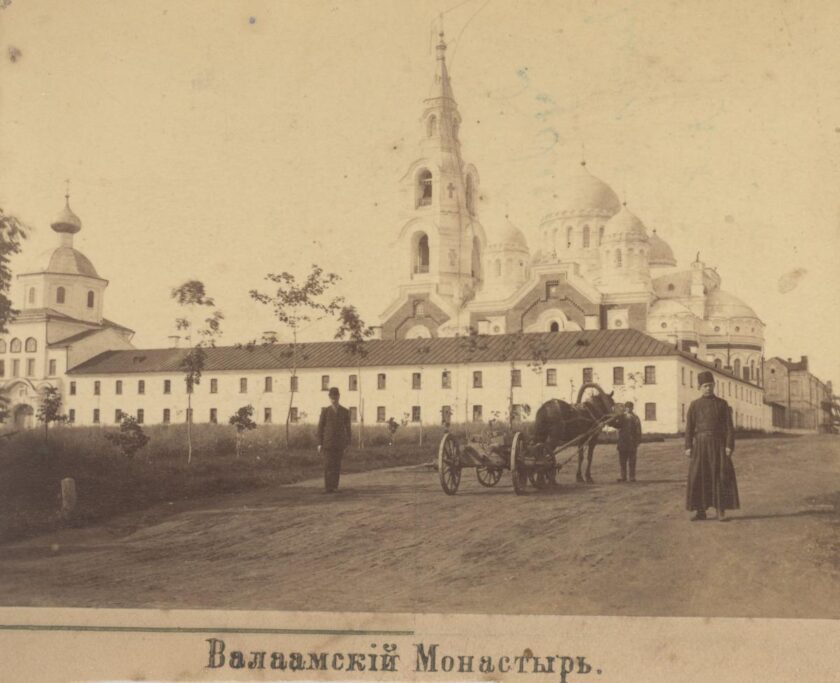
View of the Valamo Monastery. The main church in the background. Pielinen Museum, finna.fi
According to Laitila (2017, p. 101), the transformation of the Valamo Monastery into something meaningful and “sacred” for Karelian commoners may have taken place only at the end of the nineteenth century. If so, the imitations of the Valamo church bells performed by Border Karelian kantele players may likewise have originated in the nineteenth century, with some taking shape only at the turn of the twentieth century.
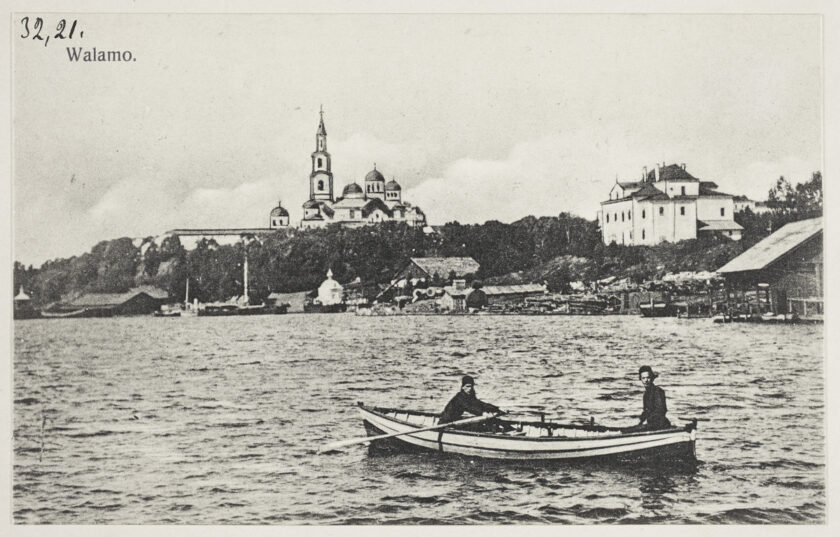
The Valamo monastery bay and the main monastery area. On the right is the hotel for Finnish pilgrims. Finnish Heritage Agency, Ethnographic Picture Collection, The Collection of the Karelian Student Nation, finna.fi.
The Meaning of Sacredness
The Karelian mindset of past centuries, which was connected to nature spirits, shares similarities with the strong commitment of today’s Indigenous peoples to natural values. The personification of nature is linked to the understanding that human activity is reflected back from nature (Robinson, 2020, pp. 98–99). The change that has taken place in Finnish culture over the centuries—and its impact on people’s thinking and perceptions of reality—is illustrated, for example, by Juha Pentikäinen’s description of the gradual acculturation of Marina Takalo, who arrived in Finland as a refugee from Viena Karelia in the 1920s:
Vietettyään suurimman osan elämästään ’vieraassa’ kulttuurimiljöössä Suomessa hän myös vieraantui oulankalaisiin rakennuksiin ja luonnonpaikkoihin paikallistuneista haltijaolennoista. Hän on joskus ihmetellytkin sitä, ettei Suomessa nähdä haltijoita niinkuin Oulangan metsissä ja vesissä. (Pentikäinen, 1971, p. 280.)
[Having spent most of her life in a ‘foreign’ cultural milieu in Finland, she also became alienated from the tutelary spirits localized in the buildings and natural places of Oulanka. She has sometimes wondered why the guardian spirits are not seen in Finland like they are in the forests and waters of Oulanka.²]
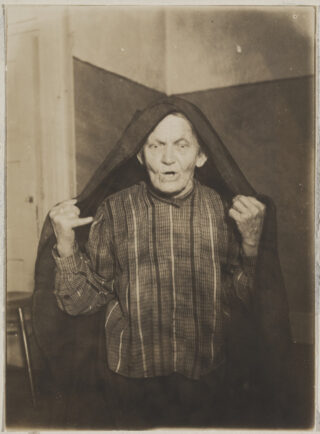
Matrona Kyyrönen from Kitilä, Impilahti, recites spells. Photo: A. O. Väisänen, 1914. The Finnish Heritage Agency, Ethnographic Picture Collection, finna.fi.
In Karelian syncretic folk religion, pre‑Christian beliefs merged with Orthodox Christianity through interaction with gods and supernatural beings. People who went on pilgrimage also took part in pre‑Christian sacrificial feasts, rites of remembrance for the dead, and rituals for communicating with nature spirits. Pilgrimages to monasteries were akin to the methods used for crisis management in everyday life. Both involved communication, reconciliation, and reciprocity, seeking to achieve balance with the saints of the Church, who were partly equated with nature spirits. (Stark‑Arola, 2002, pp. 188–191.)
The ethnologist Laura Stark has used the term folk religion to describe the Karelian syncretistic tradition (Stark‑Arola, 2002, p. 181). The folklorist Irma‑Riitta Järvinen (2004, p. 19) and the religious scholar Teuvo Laitila (2017, p. 10) have used the concept of folk piety—and Laitila also employs the term lived religion. However, Stark also identifies differences between local rituals and the sacred vows or pilgrimages associated with monasteries. For Karelians, monasteries represented perfection, in contrast to the imperfection of more secular places. In addition, the concept of “limited good”, which formed part of the Karelian worldview, generated tension and competition not only with fellow humans but also with local sacred beings; however, it was not usually associated with monasteries. The ascetic lifestyle of monastic hermits and the accumulation of monastic wealth from afar—mainly from wealthy Russian donors—placed monasteries outside the system of exchange and competition that shaped the lives of ordinary people. (Stark, 2002, pp. 175–177, 194–195.) Laitila notes that the sale of powerful objects and church practices in which monks were attributed with miracles and directed people to seek help from a miraculous icon or consecrated oil likely only reinforced common people’s concepts of religion, guardian spirits, and the supernatural world (Laitila 2017, pp. 71, 102).
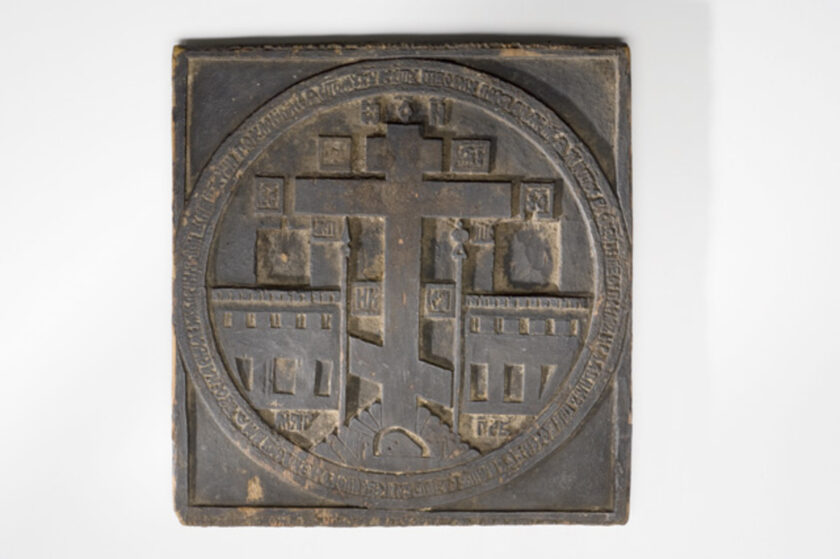
Old Believer icon. Luovutsaari, Repola, Olonets Karelia. The Finnish Heritage Agency, Finno-Ugric Collections, finna.fi.
Karelian folk religion was also influenced by the Old Believers, a protest movement within the Russian Orthodox Church that began with the Nikon Reform in 1656. Those who opposed the reform of liturgical texts were persecuted and expelled by both the state and the Church. Some of the persecuted also fled voluntarily to remote areas, where they established wilderness monasteries. Support areas for Old Believers emerged in Karelia, including the Solovki Monastery and its surrounding region. Marina Takalo, mentioned earlier, also had roots among the Old Believers. Ideas associated with the Old Believers spread to Border Karelia from the Pahkalammi and Megri monasteries in Ilomantsi. (Pentikäinen, 1971, pp. 129–131, 142.)
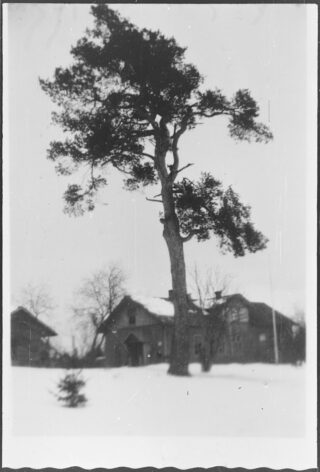
A sacred tree that served as a boundary marker for farms. According to an old belief, the tree always drops its branches from the side of the house from which the next deceased person comes. Kuljakko, Ruskeala, Border Karelia, 1930s. The Finnish Heritage Agency, Historical Picture Collection, finna.fi.
The Old Believers were respected and esteemed among Karelians, but because of state persecution, people remained silent about them. There is mention of a chamber for Old Believers in the old smokehouse of the well‑known Pedri Šemeikka (1821–1915) in the village of Kontro in Suistamo. Much has been written about the Šemeikka family, but they have not been identified as Old Believers. (Rajamo, 1944, pp. 277–278; Wartiainen, 1953, p. 52.) Both Pedri and Iivana Šemeikka—Pedri’s second cousin, recorded by Launis—were not only kantele players and runo singers but also skillful woodsmen. The author Rauno Malviniemi has compared an incident involving them—after they had recovered from a violent encounter with a swimming bear—to an Old Believer confession of sins. (Malviniemi, 1997, p. 39; Rajamo, 1944, p. 279).
A similar combination of beliefs can be seen in the Karelian attitude toward the traditional kantele. According to a saying from Säämäjärvi, “Kandeleh on Jumalan soitto. Enne Spoassu soitti kandeleheh; pahan on muut soitod naveditud.” [The kantele is God’s instrument. Before, the Saviour played the kantele; the Devil provided other instruments.] (Karelian language dictionary, search term kandeleh, word tag 23.) Because of the instrument’s sacred nature, it was also considered acceptable to play the kantele early on Sunday mornings: “Kantelehel soittahez ei ole reähky hos soitit ennem murginoa pühämpeän.” (Ibid., word tag 24.)
However, the sacred significance attributed by the Christian Church was also intertwined with the kantele’s historical association with the institution of sages. The myth of the origin of the kantele had been transmitted orally for several centuries across a wide area—extending at least from Northern Ostrobothnia to Ingria—attesting to its ritual significance in the form of spells still used as late as the nineteenth century (Ganander [1789] 1984, p. 102; SKVR VII5: 3274; SKVR IX4: 1130). In incantations, the singer‑sage’s instrument of ecstasy is the kantele (Siikala, 1999, pp. 293–294).

“Umpipuu”, a “solid wood” that grew into a ring in nature was a significant magical tool. South Karelia Museum, Käkisalmi museum items, finna.fi.
Magico‑mythic meanings were associated not only with various religious classifications—such as this world and the other world; the four elements; and living beings, including plants, animals, humans, and tutelary spirits—but also with cultural artefacts such as iron, beer, and the kantele. Each of these areas of religious life carried a specific charge of power—väki—that required special treatment. The activity of the sage was based on their own internal power—väki or mahti—with which supernatural forces were ritually controlled. (Apo, 1998, p. 71; Ganander, 1787/1997, p. 535; Siikala, 1999, pp. 75–76, 172–173.)
Texts by Karelian travellers and researchers from the turn of the twentieth century mention the old‑tradition kantele players of Border and Olonets Karelia playing their own mahti, inner power. According to these descriptions, the music was improvised and sometimes performed for listeners, while at other times it was more of an inward, spiritual journey that could last for hours along with the music (Relander, 1903, p. 78; Relander, 1917, pp. 19–20; Wartiainen (1923) 1987, p. 90). This relates to the term hiljainen haltioituminen—quiet exaltation—coined by Väisänen (1943; 1990, p. 43), and to Klemetti’s (1942, p. 4) description of Rähkönen: “…he was so enchanted by his runo vision, both when playing and when performing poems, that his earthly human nature was difficult to grasp.”²
Kantele Imitations of Church Bells
The old plucking technique has a strong influence on the auditory image and the structural character of the music being played, shaping its very essence. Not only the effect of the fingers’ interlocking along the scale on the player’s thinking, but also the complex resonance phenomenon produced by the simultaneous vibration of the strings is often unpredictable even to the performer. When the strings are plucked upwards and allowed to vibrate freely until the sound naturally fades—or until the player plucks the string again—the resulting sonority is something entirely different from the individual notes written on the stave.
The structure of each instrument naturally affects the resonance phenomenon, as does the material of the strings. The most common string material used for nineteenth‑century Karelian carved kanteles was vaski wire, which is why these instruments were also called vaskikantele. (The word vaski, found in all Uralic languages, refers to copper, iron, or metal in general. The vaski wire used in kanteles was a metal alloy in which copper was the main component.) Because of the instruments’ construction and the string material, the string tension was lower than in modern steel‑stringed kanteles, resulting in a stronger beating of the notes. For this reason, imitating the ringing of church bells and the resulting humming sound field feels very natural on a vaskikantele.
Table 1 lists the church bell melodies in the archives of the Finnish Literature Society that were recorded from kantele players between the 19th and early 20th centuries. Six of these melodies are associated with Valamo. In his own notes, Väisänen also linked Valamo to the last melody on the list, which was performed by the renowned younger-generation kantele player Antero Vornanen (1889–1937). However, Vornanen himself did not accept this attribution. In his view, the melody was simply Kirkonkellot or Kalevalan Kellot, which can be understood as connecting the piece, in his mind, to the old Kalevalaic culture. Therefore, it is possible that Väisänen added the word Valamo to the names of other church bell melodies as well, even when the performer did not use it.
At least Launis did not associate Valamo with Iivana Mišukka’s church bell piece in 1905, unlike Väisänen eleven years later. Klemetti (1942, p. 6) also wondered whether the Valamo Monastery had served as the inspiration for Everik Rähkönen’s imitation of church bells. This suggests the growing reputation and significance of the Valamo Monastery among Finns in the early decades of the 20th century. In independent Finland, there was a desire to rid the Orthodox Church of its Russian stigma and to strengthen the monastery’s position as an exotic Finnish travel destination (Parppei 2013, pp. 236–237).
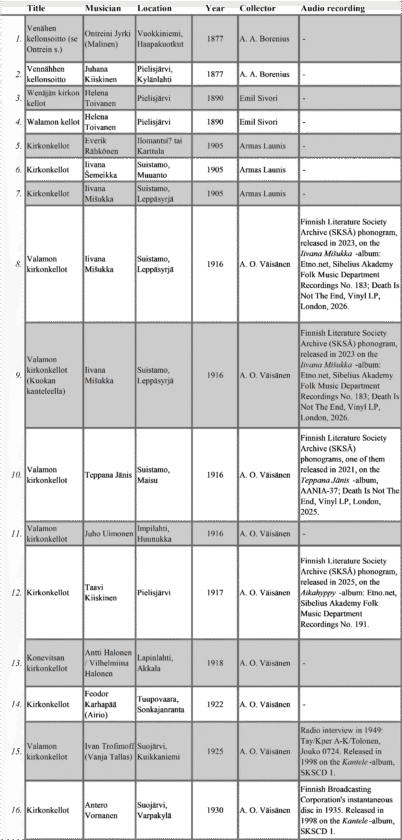
Table 1. Kantele recordings from around the turn of the 20th century imitating church bells (Finnish Literature Society Archives).
In 1928, Väisänen published thirteen of the church bell melodies listed in Table 1 among the 232 kantele tunes in Kantele- ja jouhikkosävelmiä (Väisänen [1928] 2002; pp. 2–8, 94, 135). This publication did not include Antero Vornanen’s later-recorded melody, Helena Toivanen’s “Walamon Kellot” (Krohn 1893, p. 335), which had been notated by Emil Sivori (1864–1929) and published in 1893 in the third part of Suomen Kansan Sävelmiä (Folk Dances), nor Armas Launis’s incomplete 1905 notation of Iivana Mišukka’s church bell piece, for which Väisänen provided his own musical transcription.
The two oldest church bell tunes in the archive date from Axel August Borenius’s (1846–1931) collecting trip in 1877: one from Vuokkiniemi in Viena Karelia and the other from Pielisjärvi in Finnish North Karelia. Both share the same title, and their tone referring to Russia again suggests the possibility that the name may have been modified by the notator. Jyrki Malinen (also known as Ontreini Jyrki, c. 1806–c. 1884) from Vuokkiniemi played the “Venähen kellonsoitto” for Borenius, recalling how his renowned runosinger father, Ontrei Malinen (c. 1786–1855), used to play it (SKS, A. A. Borenius’s tune collections 1877, 415, 485). Dating back to the first half of the 19th century at the latest, this tune shows that kantele players were already imitating church bells at that time, at least in Viena Karelia.
Another of Borenius’s manuscripts originates from Pielisjärvi, Finland—an old Eastern Finnish Orthodox parish—and is performed by Juhana Kiiskinen (date of birth unknown; he may possibly be Juho Juhonpoika Kiiskinen, born on 5 September 1851 and deceased in Kylänlahti, Pielisjärvi, on 13 January 1925). The tune had been known in the area for a long time, as Kiiskinen said that both his uncle and his cousin had played it. The popularity of the tune is evidenced by a variation titled “Walamon kellot” (SKS KRA Sivori, Emil 658. 1891(?)–1908), recorded by Emil Sivori in Nurmes in 1890 from Helena Toivanen, the 19‑year‑old daughter of a landowning farmer. A later variation of the same tune, titled “Kirkonkellot” (Church Bells), was recorded by Väisänen in 1917 from Taavi Kiiskinen of Pielisjärvi (possibly Taavi Juhonpoika Kiiskinen, the son of the aforementioned Juho Juhonpoika Kiiskinen, born in Kylänlahti, Pielisjärvi, on 10 July 1889 and deceased in Helsinki on 10 June 1917). Paul Salminen (1887–1949), the developer of the concert kantele, published an arrangement of the same tune as “Karjalan kirkonkellot” in his Kantelekirja sheet‑music collection in 1955, and it has since been widely performed among kantele players. (Väisänen, 2002, pp. 2–8, 94, 135; Kastinen, 2009, pp. 34, 41, 48–49; Salminen, 1955, pp. 32–33.)
There are differences in the notation of the various arrangements of the tune. Väisänen described the challenges of his own manuscript as follows: “Since there was no opportunity to notate the tunes (in Helsinki) at the same time as they were parlographed, and since no accompaniment notes can be heard from the cylinder, the tunes are therefore incomplete”² (Väisänen (1928) 2002, xl).
Emil Sivori’s notes from 1890 also include Helena Toivanen’s tune “Wenäjän kirkon kellot” (Russian Church Bells). In his publication, Väisänen categorised the piece as a more recent dance tune, writing: “Since No. 200 is an ordinary polska, it has not been included among the improvisations or the real ‘Church Bells’”² (Väisänen, 1928; 2002, p. xli). At the beginning of the twentieth century, new musical influences finally replaced the runosong culture even in the more remote eastern regions. In Border Karelia, the traditional kantele was marginalised by the popularity of the accordion, while the violin spread further west. According to Sivori, Toivanen played her tunes on both the kantele and the violin (SKS, Emil Sivori’s Melody Manuscripts, 1891–1908, 657; Kastinen, 2009, p. 48). As a young farmer’s daughter in Finnish Karelia, she was therefore already part of the more modern musical culture. This raises an essential question: if the piece in question was a conventional Western polska dance, why did she call it “The Russian Church Bells” (in case the title was given by her)? And why was her “Walamon kellot” published among folk dances, while other versions of the same tune, recorded from others, were categorised as church‑bell imitations?
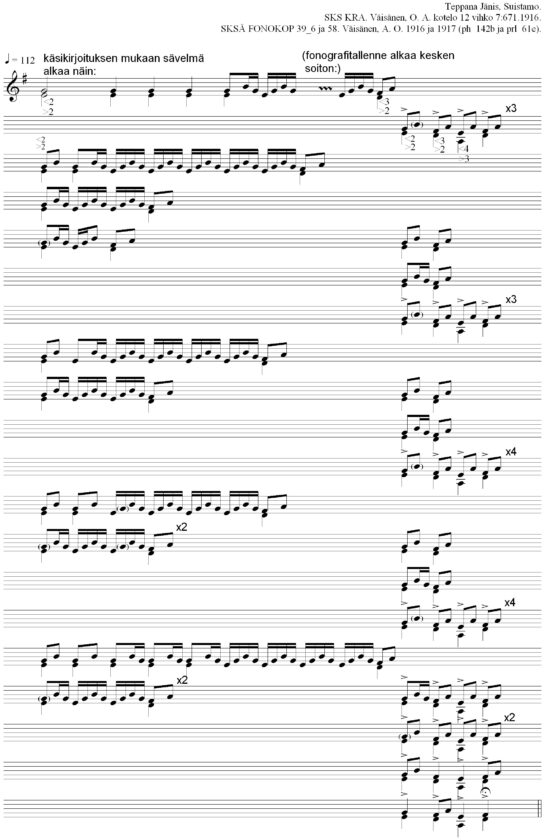
Example 3. Teppana Jänis’s Church Bells as a paradigmatic musical notation. Fingering markings: <2 = left hand index finger, >3 = right hand middle finger.
Of his own notations from 1916–1917, Väisänen published five tunes under the title “Valamon kirkonkellot” (The Church Bells of Valamo), performed by four Border Karelian musicians. These include one tune by Teppana Jänis (1850–1921) from Suistamo and two versions by Iivana Mišukka (SKS, A. O. Väisänen Archive, case 12, booklet 7:671 and booklet 8:721, 728; Väisänen [1928] 2002, pp. 4–6; Kastinen, 2013, pp. 165, 181–182).
There is also one tune by Ivan Trofimoff (later known as Vanja Tallas, 1876–1952) from Suojärvi, and one by Juho Uimonen (1847–1919) from Impilahti (SKS, A. O. Väisänen Archive, case 11, Vanja Trofimoff [2 loose leaves] 1925, and case 12, booklet 7:610; Väisänen [1928] 2002, pp. 7–8; Kastinen, 2013, pp. 129–130, 227).
In 1922, Väisänen recorded a church‑bell melody from Feodor Airio (formerly Karhapää, 1892–1967), the caretaker of St Hanna’s Church in Sonkajanranta, North Karelia, Finland (SKS, A. O. Väisänen Archive, case 3, Fedja Airio [loose sheet]; Väisänen, [1928] 2002, p. 4; Kastinen, 2013, p. 159).
In addition, Väisänen’s musical notation includes the 1918 tune “Konevitsan kirkonkellojen soitto” (The Ringing of the Konevits Church Bells), which has since gained fame through various arrangements, including the 1975 version by Piirpauke. Antti Halonen (1870–1945), the brother of the painter Pekka Halonen, played the tune for Väisänen, recalling how his mother Vilhelmiina Halonen (1840–1913) had played it in Lapinlahti, North Savo (Väisänen, 1928; 2002, pp. xix–xx, 135). Vilhelmiina Halonen held pietist religious views.
In his publication, Väisänen categorised most of the church‑bell imitations under the heading “Improvisations” and stated: “They seem to be related to certain dance tunes, which is also the impression often obtained when listening to the bells of Greek Catholic churches”² (Väisänen, 1928; 2002, pp. xix–xx, 135). This assessment appears rather superficial and reflects a particular attitude. Church‑bell ringers, pilgrims, and Orthodox clergy would hardly have considered such a characterisation appropriate.
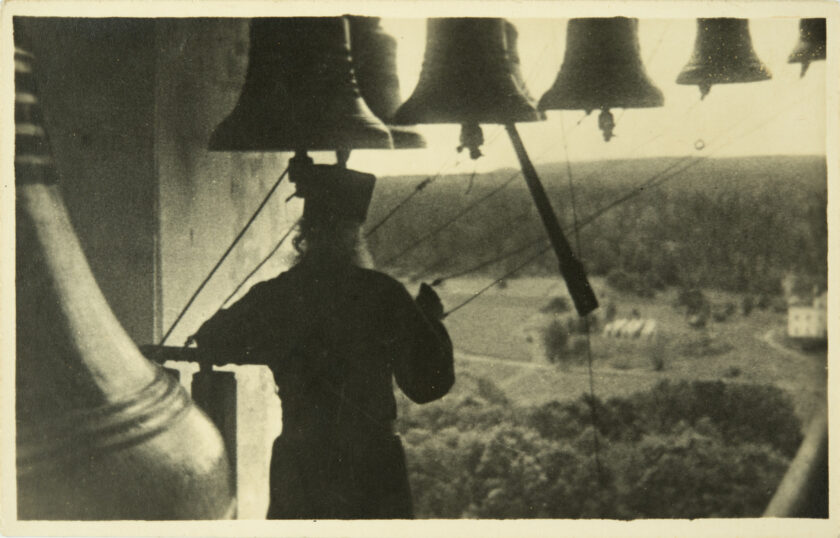
Ringer of the Valamo Church bells around 1930s. The Finnish Heritage Agency, Historical Picture Collection, finna.fi
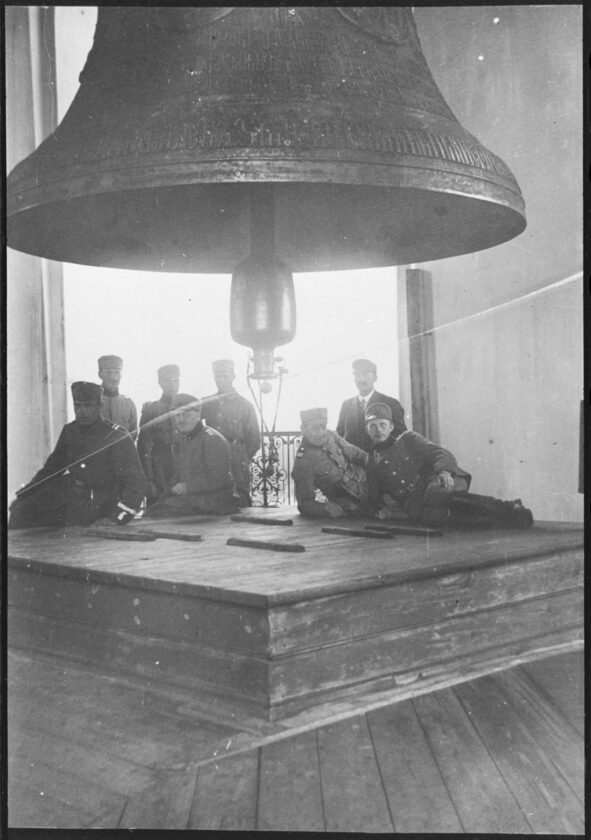
Soldiers under the bell of St. Andrew of the main church of the Valaam Monastery, the Church of the Transfiguration in the 1920s. The bell weighed 16,380 kilograms. The Finnish heritage Agency, Historical Picture Collection, finna.fi.
By the end of the nineteenth century, there were several churches and chapels on the Valamo monastery islands, each equipped with a number of bells. The monastery’s main church tower, completed in 1896, housed eighteen bells. The sound of the largest of these, the St Andrew’s bell, could be heard all the way to the northern shore of Lake Ladoga. Throughout the church year, precise instructions governed the ringing of the bells at various events and services. During major festivals, all the bells in the main church were rung, and during the Easter celebrations, anyone who wished to do so was allowed to ring them. Bell ringing can be considered a profession: for example, a monk named Isaaki was responsible for the festive bells in the main church for thirty years. (Kilpeläinen, 2000, pp. 354–356; Tammisto, 2021; Valamo Monastery Bell Ringing Regulations from 1897, Valamo Monastery Archives, Heinävesi.)
In his research, Hannu Kilpeläinen highlights the significance of bell ringing in the lives of the people of the Valamo islands. He recounts the summer experiences of twelve‑year‑old Veera Kiiske, who came to Valamo to work in the gardens and to treat a rash on her hands:
Kelloja soittamaan joka kerta läksimme. Se oli kellon soitto kohokohta aina; kun soitti nuottiin ja se jalalla. Meil oli aina mukavaa lapsil, kun läksimme sinne kelloja soittamaan. Niin se munkki ol ja otti vaan, otti meidät mielellään sinne ja kelloja soittamaan, ne ol jaloilla ja käsillä, jalolla ja käsillä. Se oli hyvin kaunis nuotti. Se soitti ja lauloi samalla kun soitti. Se lauloi tahtiin munkki samalla kun soitti. Ja myö olimma siel lapset katsomas. (Kilpeläinen, 2000, p. 334.)
[Every time we went to ring the bells. Bell ringing was always a highlight; when he rang a tune, both with the foot bell and the hand bell. We children always enjoyed going there to ring the bells. The monk would simply take us along, and he would ring the bells—on foot and by hand, on foot and by hand. It was a very beautiful melody. He rang and sang at the same time. The monk sang in tempo as he rang. And we children stood there watching.²] (The story dates back to the early twentieth century.)
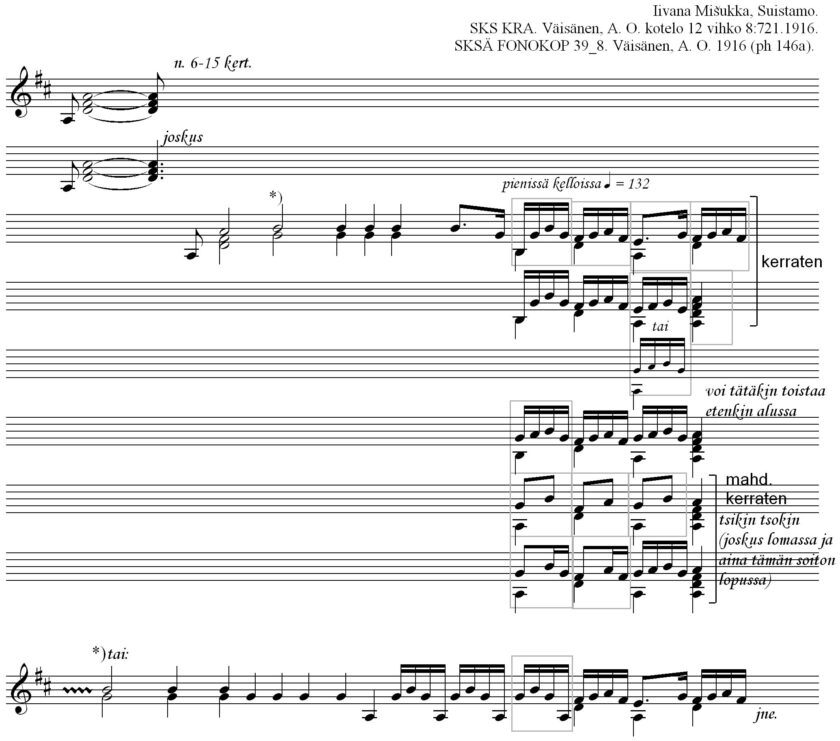
Iivana Mišukka’s Chuch Bells as a paradigmatic musical notation.
In practice, therefore, the title The Church Bells of Valamo allows for a wide range of interpretations. According to Väisänen, Teppana Jänis “was able to convey the impression of the church bells of Valamo through his performance”², even though the tune “cannot compare to the performance of the late Mišukka, for example”² (Väisänen, 1922, p. 47). When one considers the contrast between the modest tsasounas (village chapels) in the villages and the vast main church at Valamo, it is easy to understand how overwhelming a visit to the monastery must have been for many people, evoking not only visual and auditory impressions but also deeply internal experiences.
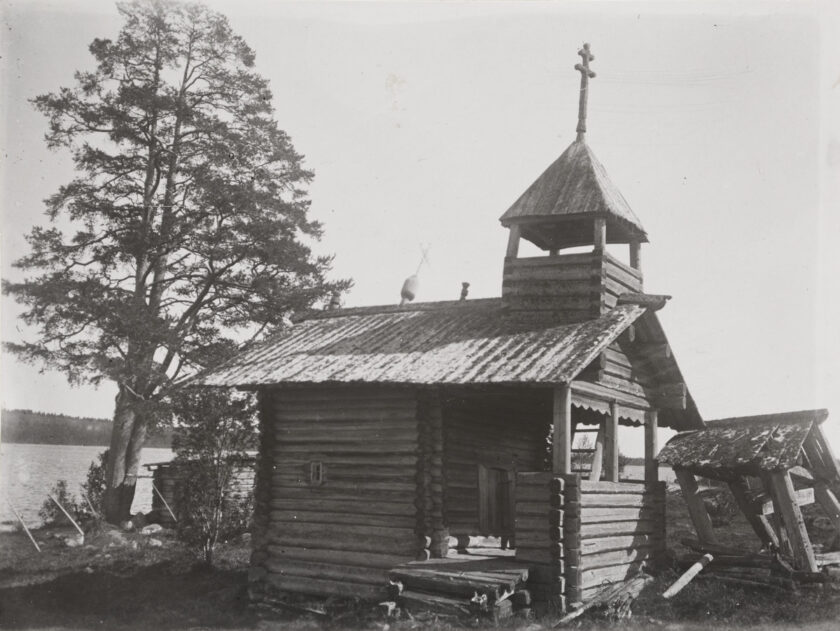
The tsasouna of Tolvajärvi, Korpiselkä. Photo: A. O. Väisänen, 1917. The Finnish Heritage Agency, Ethnographic Picture Collection, finna.fi.
Jean Sibelius’s brief mention of his 1892 trip to Karelia is a remarkable yet also thought‑provoking example of this. When recounting his memorable encounter with Pedri Šemeikka in Korpiselkä, Sibelius writes:
Myös kuulin kanteleensoittoa, jota esitti muuan heikkopäisenä pidetty nainen. Hänen kerrottiin menettäneen järkensä kuultuaan Valamon kirkonkelloja. Miten lienee hänen älynsä laita ollutkin, kannelta hän soitti mainiosti. (Väisänen, 1921, p. 77.)
[I also heard the kantele being played by a woman who was considered to be out of her mind. She was said to have lost her mind after hearing the church bells of Valamo. Whatever her wits may have been, she played the kantele splendidly.²]
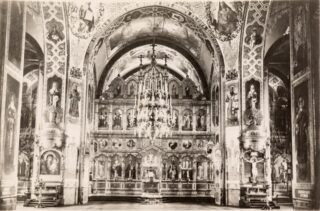
Iconostasis of the Valaam Monastery Church. Photo: Josef Stenback, 1937. The Finnish Heritage Agency, Historical Picture Collection, finna.fi.
There is no information about the woman’s identity or about when and where exactly Sibelius met her during his trip. Interestingly, Sibelius does not comment on the information given to him about her mental state; instead, he paints a very positive picture of her musical abilities. Had the woman ‘driven herself crazy’ in order to fulfil her desire to make music? Or was she perhaps labelled mentally ill by the community because she acted against prevailing norms—after all, the kantele was a male instrument in the runosong culture.
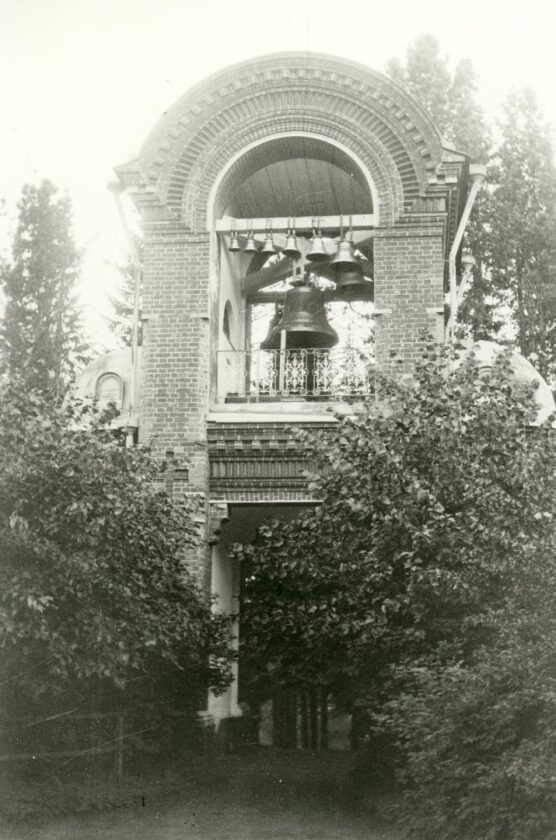
The bell tower beside the hermit cemetery church in Valamo. Photo: Väinö Hämäläinen, 193s. The Museum of Nurmes, finna.fi.
The melodies played on the kantele should probably not be understood merely as imitations of church bells, but rather as a transfer of experience, emotion, and atmosphere. Alain Corbin has described the changing meanings of church bells in rural France after the Revolution of 1789 and with the arrival of modernisation from the 1860s onwards. Bells served not only as important messengers but also carried emotional meanings that reached far back in time and deep into people’s lived experience. The harmony of the bells’ ringing guaranteed the harmony of the community and protected it from threats. The bell ringer was regarded as a sacred figure, internalising through his ringing the mystical power of the entire bell tower. The bell was not only a consecrated object but also a symbol of communal identity and cohesion. Given these meanings, the ringing of bells—and the right to control it—also became part of the exercise of power and politics. However, with the modernisation of society and changes in the soundscape, the significance of bell ringing gradually diminished. (Corbin, 1998, pp. 74–86, 95–97, 101–105, 159, 201, 211, 215–257, 282–307.)
Although it can be assumed that the meanings attached to the ringing of church bells share similarities across different denominations, the situation of the Karelian common people appears to have been quite different from that of more southern Europeans. Village tsasounas were modest and did not necessarily have a bell at all. Settlements, particularly in the northern regions, were sparse and scattered across vast, often impenetrable wilderness areas. Contacts between the church and the Karelian population were limited to only a few encounters each year. As the population grew during the nineteenth century, Orthodox church bells became increasingly present in the lives of the Karelian common people and began to acquire stronger ecclesiastical and sacred meanings.
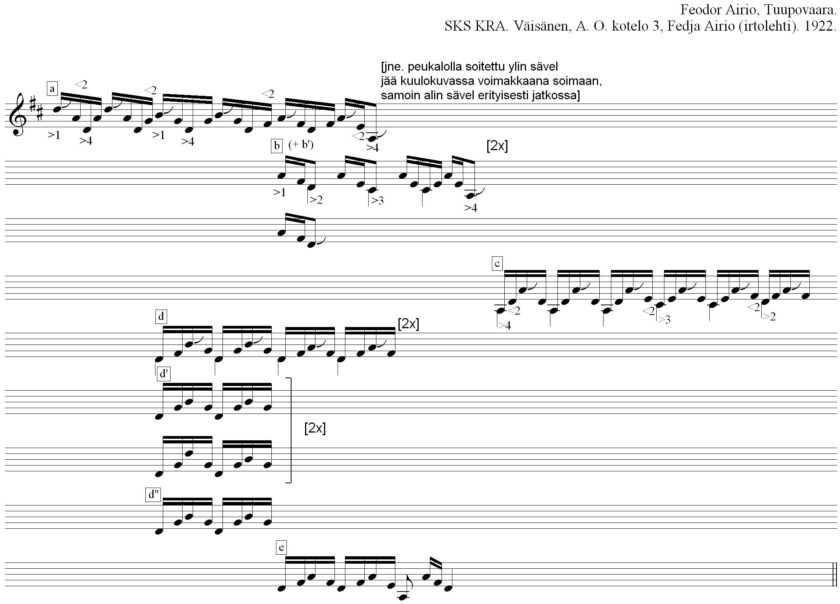
Example 5. Feodor Airio’s Church Bells as a paradicmatic musical notation.
According to Tuomo Airio, the son of Feodor Airio, playing church‑bell melodies may have been a kind of confession of faith. He also noted that his father improvised his own music and varied the melody while playing—something that the musical notation in question does not indicate (unpublished interview material: telephone interview with Tuomo Airio, 17 December 2023).
According to Väisänen ([1928] 2002, pp. xxxvii–xxxviii), Feodor Airio performed church‑bell imitations using the old plucking technique he had learned from his grandfather. He played other melodies, mainly dance tunes, using the newer technique with separate hands for accompaniment and melody. Similarly, Antero Vornanen played church‑bell melodies in the old style, as his father had, but otherwise relied primarily on the new technique (Kastinen, 2013, pp. 138–141; SKS, A. O. Väisänen Archive, case III.1, Antero Vornanen [loose sheet], 1930). Both men had modern, large kantele instruments that they had built themselves and designed for the emerging musical culture. This meant that, to some extent, the identity of the instrument had also changed for them. Presumably, for both of them the ringing of church bells was already strongly connected with the meanings of the Orthodox faith, even though their bell‑imitations, through their playing technique, were also linked to the older kantele tradition.
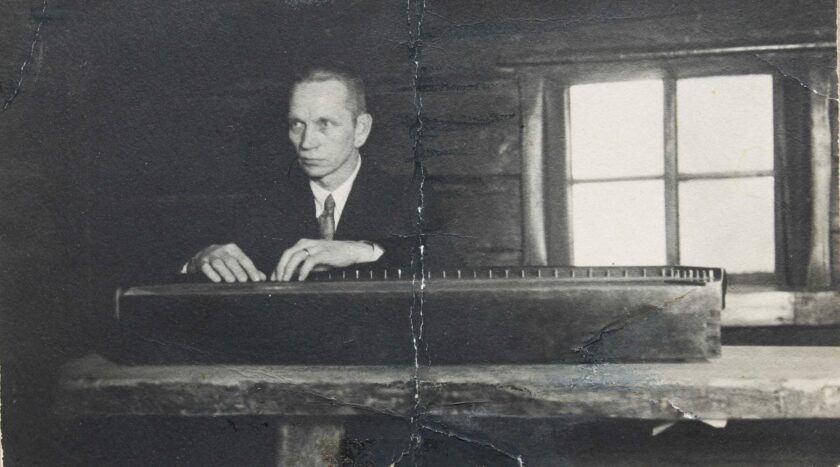
Antero Vornanen, Varpakylä, Suojärvi, perhaps in the 1930s. The home album of Hannu and Kirsti Piminäinen.
Where Do We Go from Here
Church‑bell imitations constitute only a small part of the music recorded from Karelian kantele players at the turn of the twentieth century. In relation to the antiquity of the tradition, they are unlikely to be much older than many of the dance tunes that were notated. Yet they are connected to social and cultural meanings whose roots reach far deeper into folk belief and the meanings of the sacred: the merging of the kantele’s sound and playing practices with ancient belief systems, as well as the intertwining of Orthodox saints with pre‑Christian spirits and guardian beings. They are also linked to the Karelians’ complex and evolving relationship with the monasteries over the decades, and to the nature of music itself as it relates to earlier scales and modes of musical thought.
Understanding these connections has helped to bridge the gap that has emerged between a community lost to history and the preconceptions shaped by our own thinking, grounded as it is in the aesthetics of Western musical culture. Reaching across this gap makes it possible both to perceive the centuries‑old continuities of the tradition more broadly and to keep its music alive—not by clinging to insufficient notational representations, but by internalising the essence of the music and trusting in the power of improvisation and musical experience.
The diverse workshops carried out as part of the revival of old‑style small‑kantele music have strengthened the view that the tradition can indeed continue in our time. Participants’ visibly enraptured reactions to the shared soundscape and to the communicative possibilities opened by improvisation on the small kantele demonstrate the power of the old musical aesthetics. As a deeper understanding of the tradition encourages us to look beyond the sheet music and to create music that is meaningful for us today, it also connects the original culture and its musicians to the listener’s “own time” history—one that weaves together past, present, and future.
[1] In this article, runosong culture denotes the communal use of Kalevala‑metre runosong in past centuries, including its roles in everyday life, celebrations, rituals, spells, lamentations, and instrumental music played on shepherds’ instruments and the kantele.
[2] Translation into English by the author.
References
Unpublished archival material
Finnish Literature Society (SKS) Archive, Helsinki
SKS KIA. Axel August Borenius’s archive. Travelogues, diaries and notes about kantele players and melodies from the collecting trips of 1876–1877. Case 1.
SKS KRA. Armas Launis’s Collection. Includes a bound volume: Launis Armas e) 1–1615. 1902–1905.
SKS KRA. A. O. Väisänen’s archive.
SKS KRA. Emil Sivori’s Collection. Includes a bound volume: Sivori Emil 2: 56–874 1891(?)–1908.
Sound Archive (SKSÄ).
Valamo Monastery Archive, Heinävesi
Excerpts from the bell‑ringing regulations of the First‑Class Monastery of Valamo. Compiled and written in 1897 by Aleksi Puškarnyi, bell ringer and rassophore monk of the First‑Class Monastery of Valamo.
Yleisradio Oy (Finnish Broadcasting Corporation). Radioarchive ARK 6180–2.
Online databases
Karjalan kielen sanakirja (Karelian language dictionary), 2024. Kotimaisten kielten keskuksen verkkojulkaisuja 18. URN:NBN:fi:kotus-201113 (ISBN 978-952-5446-70-8). Updateable publication. Updated Nov 27.2023. https://kaino.kotus.fi/kks/ [accessed Feb 15 2026].
SKVR-verkkopalvelu 2024–. Toimittaneet Jukka Saarinen, Niklas Alén, Maria Niku, kati Kallio ja Eija Stark. Helsinki: SKS. https://aineistot.finlit.fi/exist/apps/skvr [accessed 15 Feb 2026].
Oral Communications
Telephone interview with Tuomo Airio on 17 December 2023. Interview conducted by the author.
Magazines and newspapers
Klemetti, Heikki: Kalevalajuhlien jälkimaininkeja. Suomen musiikkilehti 3/1935, 50–52.
Klemetti, Heikki: Urhot kumpuin yöstä. Nikolai Rähkönen, in memoriam. Suomen musiikkilehti 1/1942, 4–6.
Launis, Armas: Karelen, Juni 1905. Finsk Musikrevy 13–14/1905, 261–264.
Palo, Jukka: Mikä Pähkinäsaaren rauhan raja oikeasti oli? Lääketieteellinen Aikakauskirja Duodecim 2020, 136(24): 2796–2800. Online magazine. https://www.duodecimlehti.fi/duo15965 [accessed 15 Feb 2026].
Tammisto, Ossi: Luostarin kuolinsoitto – Valamon ison kellon tarina. Blogikirjoitus 26.7.2021. https://kirkkohistoriankahinaa.blogspot.com/2021/07/luostarin-kuolinsoitto-valamon-ison.html [accessed 15 Feb 2026].
Väisänen, A. O.: Karjalaisen kanteleensoittajan manalle matkatessa. Suomen Kuvalehti 2/1922, 46–47.
Scholarly Literature and Other Published Sources
Apo, Satu: ”Ex cunno Come the Folk and Force”. Concepts of Women’s Dynamistic Power in Finnish-Karelian Tradition. In the book Gender and Folklore. Perspectives on Finnish and Karelian Culture. Ed. by Satu Apo, Aili Nenola ja Laura Stark-Arola. Studia Fennica Folkloristica 4. SKS, Helsinki 1998, 63–91.
Asplund, Anneli; Hoppu, Petri; Laitinen, Heikki; Leisiö, Timo; Saha, Hannu; Westerholm, Simo: Suomen musiikin historia. Kansanmusiikki. WSOY, Porvoo 2006.
Brander, U.: Maatalous ja mahdollisuudet Raja-Karjalassa. Rajaseutu. Suomen Rajaseutuyhdistyksen aikakauskirja. Laatokan-Karjalan erikoisnumero 2/1928, 51–64.
Carr, Edward Hallet: Mitä historia on? (Engl. alkuteos What Is History? 1961.) Suom. Sirkka Ahonen. Otava, Helsinki 1963.
Corbin, Alain: Village Bells. Sound and Meaning in the 19th-Century French Countryside. Columbia University Press, New York 1998.
Ganander, Christfrid: Mythologia Fennica. SKS, Helsinki (1789) 1984.
Ganander, Christfrid: Nytt Finskt Lexicon. Alkuperäiskäsikirjoituksesta ja sen näköispainoksesta toimittanut Liisa Nuutinen. SKS, Helsinki (1787) 1997.
Haapala, Pertti: Sosiaalihistoria. Johdatus tutkimukseen. SHS, Helsinki 1989.
Haavio, Martti: Väinämöinen. Suomalaisten runojen keskushahmo. WSOY, Porvoo 1950.
Huovila, Marja: Käkisalmen läänin vaiheita esihistoriasta vuoteen 1811. Esan Kirjapaino Oy, Lahti 1995.
Hämynen, Tapio: Liikkeellä leivän tähden. Raja-Karjalan väestö ja sen toimeentulo 1880–1940. Historiallisia Tutkimuksia 170. SHS, Helsinki 1993.
Järvinen, Irma-Riitta: Karjalan pyhät kertomukset. Tutkimus livvinkielisen alueen legendaperinteestä ja kansanuskon muutoksista. Suomalaisen Kirjallisuuden Seuran toimituksia 962. SKS, Helsinki 2004.
Kalela, Jorma: Teoriattomuus historiantutkimuksen yhteiskuntasuhteessa. In the book Menneisyyden rakentajat. Teoriat historiantutkimuksessa. Toim. Matti O. Hannikainen, Mirkka Danielsbacka ja Tuomas Tepora. Gaudeamus Oy, Helsinki 2018, 20–45.
Kalela, Jorma: Historiantutkimus ja historia. Gaudeamus Oy, Helsinki (2000) 2020.
Kallio, Kati: Armas Launis, inkeriläinen runolaulu ja Kullervo-oopperan venäläinen tausta. Musiikki, 3–4 2012, 6–28.
Kallio, Petri: The Diversification of Proto-Finnic. In the book Fibula, Fabula, Fact: The Viking Age in Finland. Ed. by Joonas Ahola, Frog ja Clive Tolley. Studia Fennica Historica 18. SKS, Helsinki 2014, 155–168.
Kastinen, Arja: Taivas auki. Itäisen Suomen ja Karjalan kanteleista 1800-luvun käsikirjoituksissa. Temps Oy, Pöytyä 2009.
Kastinen, Arja: Musiikki. In the book Kizavirzi karjalaisesta kanteleperinteestä 1900-luvun alussa. Arja Kastinen, Rauno Nieminen ja Anna-Liisa Tenhunen. Temps Oy, Pöytyä 2013.
Kastinen, Arja: Six Hours of Exploratory Improvisation. Research Catalogue 2021. https://www.researchcatalogue.net/view/1089971/1089972 [accessed 15 Feb 2026].
Kastinen, Arja: Connected Alone. An Ancient Musical Culture As a Tool For Self-Expression Today. RUUKKU – Studies in Artistic Research, 18 2022. Verkkojulkaisu. https://doi.org/10.22501/ruu.1088859 [accessed 15 Feb 2026].
Kilpeläinen, Hannu: Valamo – Karjalaisten luostari? Luostarin ja yhteiskunnan interaktio maailmansotien välisenä aikana. SKS, Helsinki 2000.
Kirkinen, Heikki: Valamon luostarin perustamiset. In the book Te menitte asumaan meren saareen… Tutkimuksia Valamon luostarista. Ed. by Sari Hirvonen, Hannu Kilpeläinen ja Leena Mäkelä. Valamon luostarin kirjaston julkaisuja 1. Heinävesi 1994, 41–58.
Korpela, Jukka: The World of Ladoga. Society, Trade, Transformation and State Building in the Eastern Fennoscandian Boreal Forest Zone c. 1000–1555. Lit Verlag, Münster 2008.
Krohn, Ilmari (ed.): Suomen Kansan Sävelmiä. Kolmas jakso. Kansantansseja. SKS, Helsinki 1893.
Kuusi, Matti (toim.): Suomen kirjallisuus I. Kirjoittamaton kirjallisuus. SKS ja Kustannusosakeyhtiö Otava, Helsinki 1963.
Kuzmin, Denis: Saamelainen asutus Karjalassa. In the book Suomalais-Ugrilaisen Seuran Aikakauskirja 94. Tiedekirja, Helsinki 2013, 69–123.
Laasonen, Pentti: Novgorodin imu. Miksi ortodoksit muuttivat Venäjälle Käkisalmen läänistä 1600-luvulla? Historiallisia Tutkimuksia 222. SKS, Helsinki 2005.
Laitila, Teuvo: Jumalat, haltiat ja pyhät. Eletty ortodoksisuus Karjalassa 1000–1900. Suomen Kirkkohistoriallinen Seura, Helsinki 2017.
Laitinen, Heikki: Kanteleen historian käännekohtia. In the book Kantele. Ed. by Risto Blomster. Suomalaisen Kirjallisuuden Seuran Toimituksia 1225 / Tieto. SKS, Helsinki 2010, 121–167.
Lang, Valter: Homo Fennicus. Itämerensuomalaisten etnohistoria. Kolmas, korjattu painos. Kirjokansi 276. SKS, Helsinki 2020.
Launis, Armas: Kullervo-oopperan esihistoriaa. In the book Kalevalaseuran vuosikirja I. Otava, Helsinki 1921, 164–176.
Launis, Armas: Muuan karjalainen kanteleensoittaja. In the book Kalevalaseuran vuosikirja 3. WSOY, Porvoo 1923, 227–230.
Lind, John H.: Valamon luostarin perustamisen poliittinen tausta. In the book Tutkimuksia Valamon luostarista. Valamon luostarin kirjaston julkaisuja 1. Heinävesi 1994, 33–40.
Malviniemi, Rauno: Tapion tuvilla. Shemeikkain runonlaulajat ja kanteleensoittajat. Shemeikka sukuseura, Keitele 1997.
Nussbaum, Martha C.: Creating Capabilities. The Human Development Approach. Harvard University Press, Cambridge, MA 2013.
Parppei, Kati: Laatokan Valamo. 1800-luvun luostari matkailijoiden kuvaamana. Kirjokansi 3. SKS, Helsinki 2013.
Parppei, Kati: Early Population in the Ladoga Region. In the book Lake Ladoga. The Coastal History of the Greatest Lake in Europe. Ed. by Maria Lähteenmäki ja Isaac Land. Studia Fennica Historica 27. SKS, Helsinki 2023, 69–88.
Pentikäinen, Juha: Marina Takalon uskonto. Suomalaisen Kirjallisuuden Seuran Toimituksia 299. SKS, Helsinki 1971.
Pöllä, Matti: Vienan Karjalan etnisen koostumuksen muutokset 1600–1800-luvulla. Suomalaisen Kirjallisuuden Seuran Toimituksia 635. SKS, Helsinki 1995.
Rajamo, M.: Suistamon seurakunnan historia. Suistamon seurakunta, Kuopio 1944.
Relander, Oskar: Suomen maakunnat. Pohjois- ja Itä-Karjala. Kansanvalistusseura, Helsinki 1903.
Relander, Oskar: O. A. Hainari. Muistelmia. Kansanvalistusseuran toimituksia 175. Kansanvalistusseura, Helsinki 1917.
Robinson, Dylan: Hungry Listening. Resonant Theory for Indigenous Sound Studies. University of Minnesota Press, Minneapolis 2020.
Saksa, Aleksandr; Uino, Pirjo; Hiekkanen, Markus: Ristiretkiaika 1100–1300 jKr. In the book Viipurin läänin historia I. Karjalan synty. Ed. by Matti Saarnisto. Karjalan kirjapaino, Lappeenranta 2003, 383–474.
Salminen, Paul: Kantelekirja. Fazer, 1955.
Sen, Amartya: Development as Freedom. Oxford University Press, Oxford 1999.
Siikala, Anna-Leena: Runolaulun käytäntö ja runoston kehitys. In the book Runo, alue, merkitys. Kirjoituksia vanhan kansanrunon alueellisesta muotoutumisesta. Ed. by Pekka Hakamies. Joensuun yliopisto, Karjalan tutkimuslaitoksen julkaisuja 92, Joensuu, 1990, 7–28.
Siikala, Anna-Leena: Suomalainen šamanismi – mielikuvien historiaa. Kolmas painos. SKS, Helsinki 1999.
Siikala, Anna-Leena: Itämerensuomalaisten mytologia. Suomalaisen Kirjallisuuden Seuran Toimituksia 1388 / Tiede. SKS, Helsinki 2014.
Siirala, Pia: Kuulokulmia tšuktšien henkilölauluun. Säveltämällä kuuleminen taiteellisen tutkimuksen menetelmänä. Taiteellisen tohtorintutkinnon tutkielma. Sibelius-Akatemian kansanmusiikkijulkaisuja 40. Taideyliopiston Sibelius-Akatemia, Helsinki 2024. https://urn.fi/URN:ISBN:978-952-329-359-5 [accessed 15 Feb 2026].
Stark, Laura: Peasants, Pilgrims, and Sacred Promises. Ritual and the Supernatural in Orthodox Karelian Folk Religion. Studia Fennica Folkloristica 11. Finnish Literature Society, Helsinki 2002.
Stark-Arola, Laura: Pyhä raja ja pyhä keskus. Rituaalimallit ortodoksisen Karjalan kansanuskonnossa. In the book Pyhän perintö. Kirjoituksia suomalaisesta pyhästä Kalevalassa, kansanperinteessä, luonnossa ja taiteessa. Ed. by Pekka Laaksonen ja Sirkka-Liisa Mettomäki. Kalevalaseuran vuosikirja 79–80. SKS, Helsinki 2002, 181–219.
Tenhunen, Anna-Liisa: Symbolista käyttösoittimeksi. In the book Kantele. Ed. by Risto Blomster. Suomalaisen Kirjallisuuden Seuran Toimituksia 1225 / Tieto. SKS, Helsinki 2010, 209–221.
Tenhunen, Anna-Liisa: Averki (Everik) Rähkönen. In the book Kizavirzi karjalaisesta kanteleperinteestä 1900-luvun alussa. Arja Kastinen, Rauno Nieminen ja Anna-Liisa Tenhunen. Temps Oy, Pöytyä 2013, 36–38.
SKVR Suomen Kansan Vanhat Runot. SKS, Helsinki 1908–1948, 1997.
Uino, Pirjo: Ancient Karelia. Archeological studies. Muinaismuistoyhdistyksen aikakauskirja 104. Suomen Muinaismuistoyhdistys, Helsinki 1997.
Väisänen, A. O.: Jean Sibelius vaikutelmistaan. In the book Kalevalaseuran vuosikirja I. Otava, Helsinki 1921, 77–81.
Väisänen, A. O. (toim.): Kantele- ja jouhikkosävelmiä. Suomalaisen Kirjallisuuden Seuran Toimituksia 863. 2. uudistettu painos. SKS, Helsinki (1928) 2002.
Väisänen, A. O.: Laulu ja soitto kansanelämässä (1943). In the book Hiljainen haltioituminen. A. O. Väisäsen tutkielmia kansanmusiikista. Ed. by Erkki Pekkilä. Suomalaisen Kirjallisuuden Seuran Toimituksia 527. SKS, Helsinki 1990, 42–46.
Wartiainen, Eliel: Shemeikka. Toinen painos. Pohjois-Karjalan Kirjapaino Oy, Joensuu (1923) 1987.
Wartiainen, Eliel: Kun haltiat elivät… Kuvauksia runon ja taian mailta. Kustannusliike Pohjola ja kumpp., Jyväskylä 1953.