
Church Bell Imitations as Part of Karelian Kantele Tradition
Blog
January 21, 2026
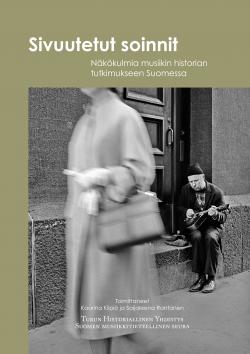 In December 2025, the Turku Historical Society and the Finnish Musicological Society published Sivuutetut soinnit: Näkökulmia musiikin historian tutkimukseen Suomessa (Sidelined Sounds: Perspectives on the Study of Music History in Finland), edited by Kaarina Kilpiö and Saijaleena Rantanen.
The book contains eleven articles organised into four thematic sections:
- Power Structures of the Enlightenment – three articles by Vesa Kurkela; Ainur Elmgren & Tiina Männistö-Funk; and Janne Mäkelä & Pekka Gronow
- The Sound of Finland: National Identity Adapted to Music – two articles by Anne Kauppala and Lasse Lehtonen
- The Marginalised: Marginal Actors of the Musical Past – three articles by Arja Kastinen; Nuppu Koivisto-Kaasik; and Matti Huttunen & Annikka Konttori-Gustafsson
- Associations and Entrepreneurship – three articles by Kaj Ahlsved; Marko Tikka; and Mikko-Olavi Seppälä
My own article, “Valamon kellot – karjalaisten kanteleensoittajien kirkonkelloimitaatioiden tausta ja merkitys ennen ja nyt” (The Bells of Valamo: The Background and Significance of Church Bell Imitations by Karelian Kantele Players, Then and Now), explores the challenges faced by today’s musician‑researcher when attempting to understand the mindset of a nineteenth‑century Karelian kantele player from a long‑term perspective.
Over the years, my research on this topic has been driven by a desire to understand the essence of music and its meaning within the framework of tradition, as well as its practical applications and its potential contributions to society today and in the future.
In the spirit of Anna‑Leena Siikala’s work, I seek to draw on research into social context and cultural meanings to approach a tradition that has long since receded. Yet unlike Siikala, whose focus lay primarily in ethnographic and historical interpretation, my own inquiry also relies on the experiential knowledge that arises from engaging with music in the present.
In addition, delving into the music of past cultures requires integrating knowledge produced in other disciplines with the act of making music. In this case, such fields include cultural history, folkloristics, archaeology, organology, and—when connected to the event of musical improvisation—also neuroscience (see research).
If the aim is to genuinely understand a person of the past, the existing source material must be examined through a critical lens: what do recordings made a hundred years ago reveal about the collector and the recording situation, and what do they leave unsaid about the tradition bearer?
It is also essential to remember that every musician’s experience is—and always has been—deeply individual, regardless of the era. I will never receive an answer to the question that continues to circle in my mind: “What do you think about when you play?” Most of the masters of the Karelian kantele tradition have vanished into history without a trace.
In the article, I also address the challenges faced by a modern‑day musician when working with the surviving fragments of information and the melody transcriptions preserved in archives; the incomplete notations offer only a blurred glimpse of moments surrounded by a wealth of details that remain invisible on the page, and by an ever‑shifting flow of music intertwined with its cultural meanings.
From a musician’s perspective, no notation can convey the essence, content, structures, progression, or cultural meanings of this tradition — the music itself.
The newly published article focuses on one small area of the Karelian kantele tradition: church bell imitations.
Because the name Valamo appears in the titles of several recorded tunes, the article examines the relationship between Karelians and the Valamo Monastery over the course of several centuries.
Despite the nearly thousand‑year influence of the Orthodox Church in the Karelian region, it seems likely that the church bell imitations played by border‑Karelian kantele players originated during the nineteenth century, with some taking shape only at the turn of the twentieth century. They are therefore probably no older than many of the dance tunes that were notated in the same period.
However, church bell imitations carry social and cultural meanings that reach back to folk religion and sacred traditions. For example, the sound and playing of the kantele are linked to ancient beliefs, just as the saints of the Orthodox Church are connected to the spiritual beings of those beliefs.
They are also linked to the complex and evolving relationship of the Karelians with monasteries, as well as to the way the very nature of the music is connected to earlier scales and modes of musical thought.
Understanding these connections has helped bridge the gap between a lost community and the preconceptions shaped by our thinking, which is grounded in the aesthetics of Western musical culture.
Bridging this divide fosters a deeper appreciation of the tradition’s centuries‑old connections and the ongoing evolution of its music. This is achieved not by clinging to inadequate musical notations, but by internalising the music’s essence and embracing the power of improvisation and lived musical experience.